Showing posts with label the 60s. Show all posts
Friday, July 5, 2013
The Rise and Fall of Legs Diamond (1960).
The Rise and Fall of Legs Diamond (1960). Directed by Budd Boetticher. The film debut of Dyan Cannon. It was nominated for an Academy Award for Best Costume Design.
After watching a couple of jewelry thieves gunned down by police, thief Jack Diamond asks dance instructor Alice for a date, she turn him down saying that she has entered a dance competition with Mr. La Tour. Jack, drops a garbage can injuring La Tour's foot, so that he can take his place and they win the trophy.
Video: Later that evening, he takes Alice to the movies, Jack then jumps out a bathroom window and robs a nearby jewelry store, pretending to be mopping the floor as people look in at the jewelry display. Then, quietly returns to his seat without Alice ever knowing. When the police questions the theater patrons, Jack uses the suspicious Alice as his alibi, but.. is later caught and sentenced to jail for the crime.
When he is paroled, Jack begs Alice to give him a job as her dance partner, but soon after completing his parole, Jack ups and leaves her. Wanting to avoid going back to jail, Jack tells his brother Eddie, who has tuberculous, that they will steal only from criminals and decides to become underworld gangster Arnold Rothstein's bodyguard.
Soon after, Jack and Eddie steal from a small-time money launderer and use the money to send Jack to Miami. Charging over $5,000 in goods to Rothstein's account, Jack has the gangster's bodyguards drag Jack in to see him. Although, Rothstein will not hire him, gangster Little Augie does, but... the McDermitt brothers gun down both Augie and Jack. Although, Augie dies, it is a miracle that Jack survives. Now, wanting to get even, he kills the McDermitt brothers and uses the murders to prove to Rothstein, that he should be his bodyguard.
Rothstein, then introduces him to crime syndicate bosses: Leo Bremer, Waxey Gordon, Big Harry Weston and Frenchy La Marr, who hires him, giving him the nickname "Legs." Rothstein, then tells his girl friend Monica to find out what Jack's plans are. Monica invites him over to her lavish apartment, but.. Jack, knows what she is up to and leaves.After leaving Monica's apartment, Jack listens at the hotel switchboard as Monica reports back to Rothstein.
Instead of firing him, Rothstein promotes Jack, to a collector and gives him a pocket watch as a gift. In order to learn how Rothstein's smuggles narcotics into the country, Jack has an affair with Monica, who gives him all the information that he is looking for.
When Rothstein confronts them about having an affair, Monica denies the accusation, but.. Jack admits that they have been seeing each other for two months. Rothstein, ends his relationship with Monica and frames Jack, by turning him over to the police, saying that there is heroin hidden in the watch's face. Although, Rothstein bails him out and offers him his old job back, Jack kills Rothstein and steals the black book containing all his business deals.
Walking into the Hotsy Totsy club, Jack announces to the other crime bosses, while they are eating sandwiches, that they will now pay twenty-five percent of their profits to him for protection. When they refuse, Jack destroys their businesses, with the help of one of their girlfriends with loose lips. (Dyan Cannon)
When the bosses henchmen shoot and severely wound Jack, he forces a cab driver to chase after the henchmen, who Jack then kills. Jack goes to Alice's apartment, who he has not seen in years and calls in an underworld doctor to take care of him. Jack, then tells Eddie to go to a Denver tubercular clinic, knowing that the crime bosses will be gunning for him.
Jack marries Alice, who is still in love with him. Meanwhile, the bosses send gangster Matt Moran to shoot Eddie in the legs as a warning to Jack to leave them alone. Jack, then goes to Moran's apartment and kills Moran and two henchmen. Alice tired of all the killings, turns Jack over to the police, but.. quickly learns that since they are married she cannot testify against him.
Later, Jack goes to the Hotsy Totsy Club, where he demands fifty percent of the bosses' profits and ownership of the club. After refusing to send money to Denver for treatment to save Eddie's life, Jack tells his two henchmen that he can not care about Eddie or anyone else because the bosses will use them to get to him.
Jack, decides to leave town and takes a depressed Alice to Europe. After, returning home he finds that the Hotsy Totsy Club, has closed because of the Prohibition Act. The new bosses try to convince Jack that stealing from them is bad for the underworld. Jack, still insists on collecting protection money, warning them that he will not be stopped by any threat, not even to his wife. Because he does not care about anybody but himself.
He returns to Alice's apartment where he learns that his friends, Sal and Fats Walsh, have left him. Alice, also leaves him, saying that he is... "as good as dead now."
Later, Jack calls on Monica to come stay with him, she takes his gun and lets two henchmen know of Jack's location... Will his luck run out.. or is it true, no bullet can kill him?
I'm very surprised after watching this film for the first time, that Ray Danton didn't go on to be a major film star. If you like crime movies, I think that you will also enjoy, The Rise and Fall of Legs Diamond . The films added bonus... it is fun to see the film debut of Dyan Cannon.
Karen Steele (March 20, 1931 – March 12, 1988). She attended the University of Hawaii and studied acting at Rollins College in Florida for a year. After that, she found work as a cover girl and model.
Steele earned her first money by spearing baby sharks in the private cove on the estate of Woolworth heiress Barbara Hutton.
Steele's first acting job was in a radio play titled Let George Do It. She subsequently appeared in the 1953 films: The Clown and Man Crazy.
The following year she landed the role of Millie Darrow in "So False and So Fair" on the television anthology Studio 57.
Her first critically acclaimed film was Marty (1955). She played Virginia and got the part because the director, Delbert Mann, confused her with an actress from New York who he and writer Paddy Chayevsky had intended to play it.
In 1958, she played the guest-star lead in the episode "Madame Faro" of Jefferson Drum, a western series starring Jeff Richards.
Steele made two guest appearances on CBS's Perry Mason, as Doris Stephanek in "The Case of the Haunted Husband" (1958) and as murder victim Carina Wileen in "The Case of the Fatal Fetish" (1965).
She appeared as Mae Dailey in the 1961 episode "Big Time Blues" on the ABC/Warner Brothers drama,
The Roaring 20's.
Earlier, she was cast in a guest-starring role in the TV series, The Alaskans, starring Roger Moore and Dorothy Provine.
Her character in "Survival of the Fattest", a 1965 episode of Get Smart, was named Mary 'Jack' Armstrong, said to be "the strongest female enemy agent in the world". This is a reference to Jack Armstrong, the clean-cut fictional hero of Jack Armstrong the All American Boy, an adventure series broadcast on radio from 1933 to 1951.
Like many actresses, as she got older she turned to television commercials for income. She also became involved in charitable causes and community service.
In early 1970, she went on a handshake tour of service hospitals in the South Pacific. She turned down a series that would have brought her $78,000 in order to make the trip and in the process lost her agent.
In later life she settled in Golden Valley, Arizona, and married Dr. Maurice Boyd Ruland, a psychiatrist at the Mohave Mental Health Clinic. They were married until she died of cancer, aged 56.
Tuesday, July 2, 2013
The Picasso Summer (1969)
The Picasso Summer (1969). Cast: Albert Finney, Yvette Mimieux, Luis Miguel Dominguín and Theodore Marcuse. Based on a short story by Ray Bradbury, "The Picasso Summer." Animation created by John Hubley, musical score by Michel Legrand.
George a hardworking Architect, can't seem to forget his dreams that he once had back in art school and wonders why he has settled for security rather than fulfillment. His loving wife Alice, knows George is troubled by it. After, a restless night looking at the paintings on their walls, George suggests that they pack their bags and run off to the beautiful south of France countryside to visit, Pablo Picasso.
They find his villa, but.. he does not seem to be there. George goes to Spain, alone to try to find a friend of Picasso. While in Spain, he learns to bullfight. There is sequence of a real bullfight (that I did not watch, to gory for me)..
The couple reunite for a final swim in the ocean before going home...
Quite a few of the 1970's film techniques are used in this fun/trippy psychedelic adventure film, in which Picasso's paintings are brought to life.. There are three animated sequences: the first is about war and peace, the second sex and the third bullfighting.
It seems, George.. really isn't looking for Picasso, but for his own answers to life. I loved the final scene on the beach where the artiest is drawing in the sand with a stick.
There is a video located on youtube if you care to run over there to take a look at the animated sequences.
On February 25, 1939, the architect Frank Lloyd Wright visited the studio and brought with him a copy of the Russian animated movie The Tale of the Czar Durandai (1934). Wright thought that the different style and design, that was very different from the typical Disney animation, would inspire and give the animators new ideas. Hubley liked what he saw and was influenced by it. He left the company during Disney animators' strike in 1941, and found work directing films for Screen Gems and the Army's First Motion Picture Unit until he joined United Productions of America.
In 1949 he was the creator of the Mr. Magoo cartoon character, based on an uncle, and directed the first Magoo cartoon with Jim Backus voicing Magoo.
He founded Storyboard Studios and then moved to New York in 1955, where he switched production over to independent short films.
Hubley was originally the director of Watership Down, until his death which caused producer Martin Rosen to take over. Some of his work, including the opening sequence, remain in the final version.
He married Faith Elliott (September 16, 1924 – December 7, 2001) the same year as the studio's move, and they collaborated on nearly every film he made until his death in 1977 at age 62 during heart surgery; their final production was A Doonesbury Special, which aired on NBC in November of that year.
Faith and their four children carried on his legacy in the renamed Hubley Studios. Hubley is survived by his daughters Georgia Hubley, who plays drums and sings for the rock band, Yo La Tengo as well as Emily Hubley, a filmmaker and animator, who has made numerous short films, including animated inserts and segments for documentaries such as Blue Vinyl and the film version of Hedwig and the Angry Inch, and a feature called The Toe Tactic which combines live action and animation. His two other children with Faith Hubley were Mark and Ray Hubley, whose voices were used for the Academy Award for Best Animated Short Film-winning Moonbird. Children with Claudia Ross are son Mark Ross Hubley an accomplished second generation animator, grandson Miles Hubley film director and editor. Daughters Anne Hubley Ricchiuti and Susan Hubley Blakely.
Tuesday, May 28, 2013
That Touch of Mink(1962).
That Touch of Mink(1962). Romantic/comedy starring Cary Grant and Doris Day, and directed by Delbert Mann. The film co-stars Gig Young, John Astin, Audrey Meadows and Dick Sargent. In addition, baseball stars Mickey Mantle, Roger Maris and Yogi Berra make cameo appearances.
Standing on a street corner Cathy Timberlake, is splattered with mud by a passing limousine belonging to tycoon Philip Shayne.
Later, Philip watches as Cathy enters an auto-mat and sends his financial adviser, Roger, to apologize and pay for her ruined dress. Insulted, Cathy decides to visit Philip personally to give him a piece of her mind. After meeting the handsome, suave, charmer, smitten... she agrees to join him on a business trip to Baltimore.
Philip then takes Cathy on a whirlwind trip to Philadelphia for cocktails, Manhattan for his speech at the U. N., and then on to a romantic dinner and a baseball game, where she sits with the NY team. He has romance on his mind when he suggests a trip to Bermuda. At first Cathy refuses, but later finds herself flying to the island with a beautiful new wardrobe, including a mink coat, gifted to her by her handsome date..
Cathy is so nervous about what is expected of her that she develops a skin rash and Philip spends the night playing gin rummy with another rejected man.
Back in New York, Cathy feels ashamed of herself and decides to return for a second attempt at romance. This time she gets drunk and falls off a balcony.
Philip, bored with her antics decides to move on and returns to New York without her. Cathy, can't live without him, comes up with a plan to make him jealous, by going to a motel with the creepy unemployment clerk, Beasley. Will Philip get there in time to rescue Kathy?
Fun Facts:
Cary Grant was a big fan of The Honeymooners and Audrey Meadows in particular, and was responsible for getting her the part of Connie.
In her autobiography, Doris Day wrote that Cary Grant was very professional and exacting with details, helping her with her wardrobe choices for the film and decorating the library set with his own books from home. However, he was a completely private person, totally reserved and very distant. Their relationship on this film was amicable but totally devoid of give-and-take.
When Roger (Gig Young)is showing Cathy (Doris Day) the list of potential husbands for her, we learn that one of the names on the list is Rock Hudson, Day's co-star in Pillow Talk, Lover Come Back and Send Me No Flowers.
Rock Hudson had expected to be cast as Philip, but director Delbert Mann wanted Cary Grant.
Cary Grant hated the finished film.
Doris Day (April 3, 1922), began her career as a big band singer in 1939. Her popularity began to rise after her first hit recording, "Sentimental Journey", in 1945.
After leaving Les Brown & His Band of Renown to try a solo career, she started her long-lasting partnership with Columbia Records, which would remain her only recording label. The contract lasted from 1947 to 1967, and included more than 650 recordings, making Day one of the most popular and acclaimed singers of the 20th century.
In 1948, after being persuaded by Sammy Cahn, Jule Styne and her agent at the time, Al Levy, she auditioned for Michael Curtiz, which led to her being cast in the female lead role in Romance on the High Seas.
Over the course of her career, Day appeared in 39 films. She was ranked the biggest box office star for four years (1960 1962–1964) and ranked in the top 10 for ten years (1951–1952, 1959–1966). She became the top-ranking female box office star of all time and is currently ranked sixth among the top 10 box office performers (male and female), as of 2012.
She also received an Academy Award nomination for her performance in Pillow Talk, won three Henrietta Awards (World Film Favorite), the Los Angeles Film Critics Association's Career Achievement Award and, in 1989, received the Cecil B. DeMille Award for lifetime achievement in motion pictures.
Day made her last film in 1968.
Day has also released 29 albums, and her songs have spent a total of 460 weeks in the Top 40 charts.
She has been awarded a Grammy Lifetime Achievement Award and a Legend Award from the Society of Singers.
In 2011, she released her 29th studio album My Heart, which debuted at #9 on the UK Top 40 charts.
Day is the oldest artist to score a UK Top 10 with an album featuring new material.
Her strong commitment to animal welfare began in 1971, when she co-founded "Actors and Others for Animals". She started her own non-profit organization in the late 1970's, the Doris Day Animal Foundation and, later, the Doris Day Animal League. Establishing the annual observance Spay Day USA in 1994, The Doris Day Animal League now partners with the Humane Society of the United States and continues to be a leading advocacy organization.
In 2004, she received the Presidential Medal of Freedom from President George W. Bush in recognition of her distinguished service to the country.
Day has since retired from acting and performing, but has continued her work in animal rights causes and animal welfare. She currently lives in Carmel-by-the-Sea, California.
Saturday, May 25, 2013
Father Goose(1964).
Father Goose(1964). Romantic/comedy set in World War II. Cast: Cary Grant, Leslie Caron and Trevor Howard. The title comes from "Mother Goose", the code-name assigned to Grant's character. The film won an Academy Award for its screenplay. The film introduced the song "Pass Me By" by Cy Coleman and Carolyn Leigh, later recorded by Peggy Lee'
At the outbreak of World War II, American whiskey-loving beachcomber Walter Eckland is tricked by his friend, Australian Navy Comdr. Frank Houghton, into becoming a coast-watcher on a lonely South Pacific island. Under the code name "Mother Goose."
With plans to rescue a spotter from another island, Eckland discovers that he has been killed by the Japanese and instead finds seven stranded schoolgirls and their goody two shoes French teacher, Catherine Freneau.
The two adults can not seem to get along, with Catherine trying to reform the unshaven Filthy Beast Eckland, of his drinking and salty language.
Things take a turn for the worse when the girls mistakenly tell Eckland that Catherine has been bitten by a poisonous snake. To ease her final hours, Eckland gets her drunk and admits that he used to be a history professor.
They fall in love and are married by radio during an air raid after it is revealed that the "snake" was actually a big stick. Houghton sends a submarine to rescue them but, the Japanese have different ideas...
Trevor Howard, is so believable in his part as Australian Navy Comdr. that he gives Gary Grant a run for his money. Cary and Leslie Caron make their unlikely match seem like a lot of fun...
Fun Facts:
Cary Grant always claimed his role in this film was most like his real personality. He claimed he kept in touch with most of the girls as they grew up and had families of their own.
Cary Grant was offered the role of Henry Higgins in My Fair Lady but turned it down to star in this movie. He wanted Audrey Hepburn to play Catherine, but she was already committed to My Fair Lady.
The film features the same piece of stock footage of a submarine firing a torpedo that was used in Cary Grant's previous World War II comedy Operation Petticoat.
Cary Grant plays a scruffy whisky-swilling beachcomber sailor in this movie, Cary Grant is considered to be 'cast against type' as a suave sophisticated debonair on-screen persona.
Trevor Howard (29 September 1913 – 7 January 1988), was educated at Clifton College (to which he left a substantial legacy for a drama scholarship) and at the Royal Academy of Dramatic Art (RADA), acting on the London stage for several years before World War II.
His first paid work was in the play Revolt in a Reformatory (1934), before he left RADA in 1935 to take small roles.
After a theatrical role in "The Recruiting Officer" (1943), Howard began also working with cinema with The Way Ahead (1944).
The Passionate Friends though, in which Howard played a similar character to Alec in Brief Encounter was not successful.
The Third Man (1949), in which he played a British military officer and during filming in Vienna, Howard visited the fairground which was, under the jurisdiction of the Russians, still wearing the uniform of a British Army Major, he was arrested. He was returned to the SIB after his true identity was proved.
He also starred in The Key (1958) for which he received the best actor award from the British Academy of Film and Television Arts and Sons and Lovers (1960), for which he was nominated for an Academy Award for Best Actor.
Another notable film was The Heart of the Matter (1953), from another Graham Greene story. Over time Howard shifted to being one of Britain's finest character actors.
Howard's later films includ: Mutiny on the Bounty (1962), Father Goose (1964), Morituri (1965), Von Ryan's Express (1965), The Charge of the Light Brigade (1968), Battle of Britain (1969), Ryan's Daughter (1970), Superman (1978), and Gandhi (1982). The Dawning (1988) was his final film.
One of his strangest films and one he took great delight in, was Vivian Stanshall's 1980 Sir Henry at Rawlinson End in which he played the title role.
While continuing to work in film and occasionally theater, he also found work in television, winning an Emmy award for his role as the titular figure in The Invincible Mr Disraeli (1963) and being nominated for another for The Count of Monte Cristo (1975), in which he played Abbé Faria.
He declined a CBE in 1982.
Throughout his film career Howard insisted that all of his contracts held a clause excusing him from work whenever a cricket Test Match was being played.
He died on 7 January 1988, from a combination of bronchitis, influenza and jaundice, aged 74, survived by his widow Helen.
Thursday, May 23, 2013
Charade(1963). The following suggestions will help keep your garments looking their best.
Charade(1963). Is a suspenseful and fun, romantic comedy/mystery directed by Stanley Donen. Cast: Cary Grant and Audrey Hepburn, Walter Matthau, James Coburn, George Kennedy, Dominique Minot, Ned Glass, and Jacques Marin.
The film is best known for: Grant and Hepburn's on screen chemistry and having been filmed on location in Paris, for Henry Mancini's score and theme song (Charade song), and for the animated titles by Maurice Binder. It has been referred to as "the best Hitchcock movie that Hitchcock never made."
Reggie Lampert, is on a skiing trip when tells her friend Sylvie Gaudel, that she has decided to divorce her husband Charles. After finding out that her husband has been murdered after taking all their money out in cash, which is also missing. She then meets a charming stranger, Peter Joshua, who changes his name at a drop of a hat:
Reggie Lampert: "So it's goodbye Alexander Dyle and welcome home Peter Joshua".
Adam Canfield: (shakes his head) "Sorry the name is Adam Canfield".
Reggie Lampert: "Adam Canfield? Wonderful! Do you realize you've had three names in the past two days? I don't even know who I'm talking to any more!"
His partners in crime are also very interested in where the money is. To make matters worse everyone believes Regina is hiding the money. Things become complicated when the bad guys start turning up dead. One never knows whether Gary Grant is a good guy or a bad guy.
Video: It was agreed that Cary Grant would not remove his shirt in the shower scene since he was nearly sixty and slightly overweight.
Tuesday, May 21, 2013
Dead Ringer (1964)
Dead Ringer, also known as Who is Buried in my Grave? (1964). Thriller directed by Paul Henreid from a screenplay by Oscar Millard and Albert Beich from the story La Otra by Rian James. The music score was by Andre Previn and the cinematography by Ernest Haller. Cast: Bette Davis, Karl Malden and Peter Lawford with Philip Carey, Jean Hagen, George Macready, Estelle Winwood, George Chandler and Cyril Delevanti. The jazz combo in Edie's Bar was composed of electronic organist Perry Lee Blackwell and drummer Kenny Dennis, both noted musicians, but uncredited in the film.
The film is the second time Davis played twin sisters, the first, A Stolen Life(1946). For this reason, Dead Ringer is sometimes mistakenly listed as a remake of A Stolen Life.
Lana Turner turned the film down because she didn't want to play twins.
After a separation of 18 years, Edith Philips meets her twin, Margaret de Lorca, at the funeral of her husband. When Edith learns that Margaret had tricked the man she loved into marriage, she lures Margaret to her apartment, signs her own name to a suicide note and then shoots her sister.
After changing clothes with her dead sister, she moves into the de Lorca mansion and begins living her sister's life. Things are going well until she meets Margaret's secret lover, Tony Collins.
He quickly learns the truth and threatens to blackmail her, Edith realizes that he and Margaret murderd de Lorca.
They begin to struggle and Tony is killed by the family's Great Dane. The police become suspicious and exhume the body of the dead husband. Arsenic is found and Edith is arrested for murder.
She tries to convince her former boyfriend, Sgt. Jim Hobbson, that she is really Edith, but... will he ever believe her story?
If you enjoy thrillers with lots of twist and turns, this movie is for you. Even though Bette's character is a murderess, you may hope for a minute that she gets away with it. The poker scene will keep you sitting at the edge of your seat. The supporting cast is also good, especially Karl Malden.
Jean Hagen (August 3, 1923 – August 29, 1977). She studied drama at Northwestern University and worked as a theater usherette before making her Broadway theatre debut in Another Part of the Forest in 1946.
On Broadway, she was understudy for Judy Holliday in Born Yesterday.
Her film debut was as a femme fatale in Adam's Rib in 1949. The Asphalt Jungle (1950) provided Hagen with her first starring role.
She appeared in the film noir Side Street (1950) playing a gangster's sincere, but none-too-bright, gun moll.
She is best remembered for her comic performance in Singin' in the Rain as the vain and talentless silent movie star Lina Lamont; Hagen received an Academy Award nomination for Best Supporting Actress.
By 1953, she was in the television sitcom Make Room for Daddy. As the first wife of Danny Thomas, Hagen received three Emmy Award nominations, but after three seasons she left the series. Thomas, who also produced the show, reportedly didn't appreciate Jean leaving the series and her character was killed off. This was the first TV character to be killed off in a family sitcom. Marjorie Lord was cast a year later as Danny's second wife.
Hagen starred in the 1957 Alfred Hitchcock Presents, Season 3, Episode 7, entitled "Enough Rope for Two".
She performed as Frida Daniels in The Shaggy Dog with Fred MacMurray.
In 1960, she appeared as "Elizabeth" in the episode "Once Upon a Knight" of CBS's series The DuPont Show with June Allyson. Although she made frequent guest appearances in various television series, she was unable to successfully resume her film career and for the remainder of her career she played supporting roles: Marguerite LeHand, personal secretary to Franklin Delano Roosevelt in Sunrise at Campobello (1960), as the title character in season 2, episode 3 of The Andy Griffith Show titled "Andy and the Woman Speeder" (1961).
She performed as the friend of Bette Davis in, Dead Ringer (1964).
In the 1960's, Hagen's health began to decline and she spent many years hospitalized or under medical care.
In 1976, she made a comeback playing character roles in episodes of the television series: Starsky and Hutch and The Streets of San Francisco and made her final film appearance in the 1977 television movie Alexander: The Other Side of Dawn.
Jean Hagen married Tom Seidel on June 12, 1947. They had 2 children, Aric Phillip (born August 1950) and Christine (born May 16, 1952). She divorced Seidel on November 1, 1965.
Hagen died of esophageal cancer on August 29, 1977.
Monday, May 20, 2013
Beep beep'm beep beep yeah!
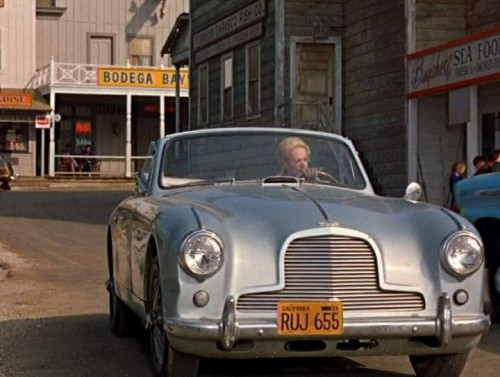
Hitchcock chose a 10-year-old Aston Martin DB2/4 Drophead Coupe, for the 1963 thriller ‘The Birds’. Driven by socialite Melanie Daniels (played by Tippi Hedren) in the beautiful Californian seaside town Bodega Bay. The Aston Coupe, is also driven when they leave the house during the final scene...
The Drophead Coupe version of the DB2 was introduced in late 1950. The two-door original, with its small ‘letter box’ boot, had been re-engineered to make it into one of the world’s first hatchbacks, offering greater rear headroom, two rear seats and the convenience of a mainly glass tailgate.
Video: This is the closest video I could find that spotlights the car used in the classic film.. The Birds(1963).
Friday, March 1, 2013
For the film, The Graduate(1967). Anne Bancroft, Dustin Hoffman, and Katharine Ross earned Oscar nominations for their performances. The film also received nominations for Best Cinematography, Best Adapted Screenplay and Best Picture.
The Graduate(1967). Comedy/drama. Directed by Mike Nichols. It is based on the 1963 novel, The Graduate by Charles Webb, who wrote it shortly after graduating from College. The screenplay was by Buck Henry, who makes a cameo appearance as a hotel clerk. Cast: Dustin Hoffman, Anne Bancroft and Katharine Ross.
Concerned about his future, 20 year old Benjamin Braddock, returns home after graduating from a college to a graduation party. His parents, are only interested their plans for him to attend graduate school.
Mrs. Robinson, the wife of his father's law partner, asks Benjamin to drive her home from the party. She then invites Benjamin, inside and tells him that she finds him attractive and that she is available to him anytime.
Mr. Robinson arrives home, but does not suspect anything. He advises Benjamin that he should "relax and enjoy his youth while he still can".
A few days later, Benjamin calls Mrs. Robinson and says that he wants to meet her at a hotel and the two begin an affair. Benjamin spends his life.. floating in a pool and sleeping with Mrs. Robinson.
Tired of Benjamin's lazy days, his parents set him up on a date with his high school friend Elaine. Mrs. Robinson, makes it clear to Benjamin that he is to have nothing to do with Elaine. Benjamin, gives into the pressure from their fathers and takes Elaine out on a date.
During their date, Benjamin goes out of his way to treat Elaine badly. When, she begins to cry, Benjamin, feels sorry for how he treated her and explains to her, that he only asked her out on a date because he was pressured into it. They become friends and talk about their future plans.
When Benjamin's arrives at the Robinson's home to take Elaine out again, Mrs. Robinson threatens to tell Elaine, about her relationship with Benjamin. Unable, to control himself.. Benjamin, blurts out the truth before Mrs. Robinson can. Heartbroken, Elaine, breaks it off and returns to Berkeley.
Benjamin, realizes that he is madly in love with Elaine and follows her to Berkeley, where he interrupts a date between Elaine and Carl. Elaine asking what he is doing there after having raped her mother while she was drunk. Benjamin, reveals that he was the one who was pursued by Mrs. Robinson, which further upsets Elaine. Benjamin tells Elaine he will leave her alone, but Elaine asks him to remain.
Benjamin, wants to get blood tests so they can get married, but.. Elaine tells him that she has already told Carl that she will marry him.
Mr. Robinson, now knows about his wife's affair with Benjamin, goes to Benjamin's apartment in Berkeley threatening to have him arr rested if Benjamin continues to date Elaine. He forces Elaine to drop out of school and takes her away to marry Carl. Elaine leaves Benjamin, a note saying that she loves him, but.. because of her father's anger he would never allow them to be married.
Benjamin, races back to Pasadena looking for Elaine, but.. finds Mrs. Robinson, who tells him he cannot stop the wedding. Benjamin, learns from Carl's fraternity brothers, that the wedding is taking place in Santa Barbara. Will he get there in time to stop the wedding?
This is an excellent film, that will take you back to the sixties when the traditional family values were beginning to change..... A Comedy/drama.. I never really did think it was a comedy.. laughing at other people's emotional problems, is really not that funny to me. I don't want to ruin the film for you.. But, I did not like the ending..
According to TCM host Robert Osborne: "Mike Nichols wanted Doris Day for Mrs. Robinson, Robert Redford for Benjamin Braddock and Gene Hackman for Mr. Robinson." But there were numerous actors and actresses considered or tested for, or who wanted, roles in the film.
Day turned down the offer because she believed the film was not for her. Nichols' actual first choice for Mrs. Robinson was French actress Jeanne Moreau. The idea behind this was that in the French culture, the "older" women tended to "train" the younger men in sexual matters.
Joan Crawford inquired as to play the part, while Ingrid Bergman and Audrey Hepburn both wanted the role.
Patricia Neal, turned down the film as she had recently recovered from a stroke and did not feel ready to accept such a major role.
Geraldine Page also turned it down.
Other actresses considered for the part included Claire Bloom, Angie Dickinson, Judy Garland, Rita Hayworth, Jennifer Jones, Deborah Kerr, Eva Marie Saint, Simone Signoret, Jean Simmons, Lana Turner, and Shelley Winters. Angela Lansbury also asked about playing the part.
Ava Gardner sought the role of Mrs. Robinson, and reportedly called Nichols saying,"I want to see you! I want to talk about this Graduate thing!". Nichols did not seriously consider her for the role (he wanted a younger woman as Bancroft was 36 and Gardner was 45), but did end up visiting her hotel. He later recounted that "she sat at a little French desk with a telephone, she went through every movie star cliche. She said, 'All right, let's talk about your movie. First of all, I strip for nobody.'"
Jane Fonda turned down not only the role of Mrs. Robinson, but also that of Elaine.
For the character of Elaine, casting was also problematic. Patty Duke turned down the part as she did not want to work at the time.
Sally Field as well as Shirley MacLaine refused the role as well. Raquel Welch and Joan Collins both wanted the role, but did not succeed in getting it.
Carroll Baker tested, but was said to be too old to be Anne Bancroft's daughter.
Candice Bergen screen-tested as well, as did Goldie Hawn and Natalie Wood.
On the other hand, Ann-Margret, Elizabeth Ashley, Karen Carpenter, Carol Lynley, Sue Lyon, Yvette Mimieux, Suzanne Pleshette, Lee Remick, Pamela Tiffin, and Tuesday Weld were all on the director's shortlist before Katharine Ross was cast.
When Dustin Hoffman auditioned for the role of Benjamin, he was asked to perform a love scene with Ross. Hoffman had never done one during his acting classes and believed that, as he said later, "a girl like Ross would never go for a guy like me in a million years".
Ross agreed, believing that Hoffman "looked about 3 feet tall ... so unkempt. This is going to be a disaster". Producer Joseph E. Levine later admitted that he at first believed that Hoffman "was one of the messenger boys".
Despite or perhaps because of Hoffman's awkwardness, Nichols chose him for the film.
Before Hoffman was cast, Robert Redford and Warren Beatty were among the top choices. Beatty turned the film down as he was occupied with Bonnie and Clyde. Redford tested for the part of Benjamin (with Candice Bergen as Elaine), but Nichols thought that Redford did not possess the underdog quality that Benjamin needed. When Mike Nichols talked with Redford, Redford asked what he meant. "Well, let's put it this way," said Nichols, "Have you ever struck out with a girl?" "What do you mean?" asked Redford. "That's precisely my point," said Nichols.
Charles Grodin turned down the part as the money was not right. Both Brandon deWilde and Michael Parks auditioned for the role.
In addition, Keir Dullea, Robert Duvall, Harrison Ford, George Hamilton, Steve McQueen, Jack Nance, George Peppard, Anthony Perkins, Robert Wagner, and Jack Nicholson were all considered for the part of Benjamin.
Burt Ward, who starred as Robin on the Batman television show, had to pass on the role as he was committed to filming the show, and the studio would not lend him any way.
In the roles of Mr. Robinson, Gene Hackman was originally cast, but just before filming began, the director decided he was too young and decided to replace him.
Marlon Brando, Howard Duff, Brian Keith, Jack Palance, Frank Sinatra, and Gregory Peck were all other choices for the role that Murray Hamilton eventually played.
Susan Hayward was the first choice for Benjamin's mother, Mrs. Braddock, but the role was given to Elizabeth Wilson. And to play Mr. Braddock, Yul Brynner, Kirk Douglas, Robert Mitchum, and Ronald Reagan all came close to getting the role that ended up going to William Daniels.
There are considerable age discrepancies between the lead roles and the actors who portrayed them. Benjamin Braddock says, "next week I will be 21"; at the time of filming, Dustin Hoffman was 30. Mrs. Robinson states, "Benjamin, I am twice your age." Anne Bancroft was 36, only six years older than Hoffman. Mrs. Robinson's daughter Elaine is 19 and was portrayed by Katharine Ross, who was 27 at the time.
According to a Variety article by Peter Bart in the 15 May 2005 issue, Lawrence Turman, his producer, then made a deal for Simon to write three new songs for the movie. By the time they had nearly finished editing the film, Simon had only written one new song. Nichols begged him for more, but Simon, who was touring constantly, told him he did not have the time. He did play him a few notes of a new song he had been working on; "It's not for the movie... it's a song about times past — about Mrs. Roosevelt and Joe DiMaggio and stuff." Nichols advised Simon, "It's now about Mrs. Robinson, not Mrs. Roosevelt."
Anne Bancroft, Dustin Hoffman, and Katharine Ross earned Oscar nominations for their performances. The film also received nominations for Best Cinematography, Best Adapted Screenplay and Best Picture.
Katharine Ross (born January 29, 1940), Studied at Santa Rosa Junior College for one year (1957-1958), where she had her introduction to acting in a production of, The King and I. She dropped out of the course and moved to San Francisco to study acting.
She joined The Actors Workshop and was with them for three years (1959-1962) working as an understudy, for one role in, The Balcony, where she appeared nude on stage. In 1964 she was cast by John Houseman as Cordelia in a production of, King Lear.
While at the Workshop, she began acting in television series in Los Angeles to earn extra money. She was brought to Hollywood by Metro, dropped, then picked up by Universal. Her first television role was in, Sam Benedict in 1962.
In 1964, Ross appeared in episodes of, Arrest and Trial, The Virginian ,Gunsmoke, The Alfred Hitchcock Hour ("Dividing Wall" episode, 1963), and made her first film, Shenandoah, followed by a starring role opposite James Garner in, Mister Buddwing with MGM in 1965. In 1966, she appeared in the episode, "To Light a Candle" of Barry Sullivan's NBC Western, The Road West.
Then came her breakout roles in two popular films: Elaine Robinson in, The Graduate (1967) and Etta Place in, Butch Cassidy and the Sundance Kid (1969). After appearing as Dustin Hoffman's girlfriend Elaine in The Graduate, a part for which she received an Oscar nomination and a Golden Globe as New Star of the Year. She also won a BAFTA for her part as an Indian in, Tell Them Willie Boy Is Here (1969).
One of her best-known roles came in 1975's The Stepford Wives, for which she won the Saturn Award for Best Actress She reprised the role of Etta Place in a 1976 ABC TV movie, Wanted: The Sundance Woman, and then won a Golden Globe for best supporting actress for her part in 1977's Voyage of the Damned; as of 2011, she, along with Shirley MacLaine in Madame Sousatzka in 1988, are the only Golden Globe winners to not get an Oscar nomination for the same performance.
She starred in several TV movies from the late 1970s, including: Murder by Natural Causes in 1979. Rodeo Girl in 1980, Murder in Texas in 1981, and the 1980s television series The Colbys opposite Charlton Heston as Francesca Scott Colby. She played Donnie's therapist in the 2001 film Donnie Darko. Her last acting role to date was as Carly Schroeder's grandmother in the 2006 independent film Eye of the Dolphin. Ross has established herself as an author, publishing several children's books.
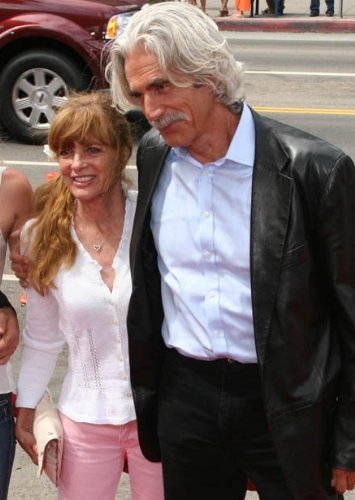
Ross has been married five times. Her first marriage was to actor Joel Fabiani from February 28, 1960 to 1962. She was then married to John Marion from May 2, 1964 to 1967. On June 1, 1969, Ross married the triple Oscar-winning cinematographer Conrad L. Hall after meeting him on the set of Butch Cassidy and the Sundance Kid. They separated in 1973. She was married to Gaetano Lisi from 1975 to 1979, after they met when he was a chauffeur and technician on The Stepford Wives. Ross is now married to actor Sam Elliott, whom she met when they co-starred in the 1978 film The Legacy (one of his first film roles was as 'Card Player #2' in the opening scene of Butch Cassidy and the Sundance Kid). The couple married in 1984 and have a daughter, Cleo Rose Elliott, born in 1984.
Wednesday, December 26, 2012
Please Don't Eat The Daisies(1960).
Please Don't Eat the Daisies (1960). Comedy. Cast: Doris Day and David Niven. Director: Charles Walters. Produced by Joe Pasternak, with Martin Melcher (Day's husband) as associate producer. The screenplay, partly inspired by the book of the same name by Jean Kerr, a collection of humorous essays, was by Isobel Lennart. The film also features Janis Paige, Spring Byington, Richard Haydn, Patsy Kelly, and Jack Weston. A television series starring Patricia Crowley and Mark Miller premiered five years later and ran for 58 episodes.
Drama professor, Lawrence Mackay, first job, as as a New York newspaper theater critic, is to review his old friend, producer Alfred North's, new Broadway musical.
On opening night, Larry's wife Kate, is visited by wannabe, playwright and cab driver, Joe Positano, who wants Larry to read his play. After Kate tries settling down her four boys, with no luck.. agrees to tell Larry about the play.
Kate meets up with Larry, while is giving his last lecture as a professor, knowing he has become a critic, his students believe he will put down every performance he reviews, just to help his own career.
Alfred's new show is terrible, Larry feels guilty, that he has to tell the truth about his friend's play.
The next morning, Alfred runs over to the apartment upset about the review, Larry tries to calm his friend.
Later, while Larry and Kate have breakfast at a restaurant, Deborah Vaughn, the star of Alfred's show, walks in and slaps Larry in front of a cameraman who captures the moment on film.
Soon the picture makes front-page headlines and Larry, decides to publish a column with the photo claiming the shows popularity failed, not because of Deborah's bad performance but on her derriere.
Days later at a cocktail party, Larry is the center of attention while Kate is ignored. When Deborah arrives at the cocktail party, she heads straight over to Larry to apologize hoping that he will reconsider his opinion of her derriere. As Kate prepares to leave the party, Alfred warns Kate that Larry is on his way to the "downelator" becoming a critic who thinks his own jokes are better than any play. As they leave, Larry makes fun of the play opening that evening.
At home after seeing the play, angry/worried Kate asks Larry if he disliked the play before seeing it. Larry promises to her he had given the play an honest review.
Days later, as Larry reads Joe's biblical play and criticizes him for writing about a subject he does not know anything about. Offended, Joe tells Larry that he is not the same man he used to be and storms out.
Soon after, Larry and Kate learn that the lease on their apartment is about up and talk about their plans to move to a large house outside the city. Now, that Larry is a success, he wants to live in the city. Using her feminine wiles, Kate agrees that his work comes first and calls the entire family a "parasite". Larry charmed by her agrees to the move.
With not many choices in their price range, the family moves into a huge fixer upper of a house in Hooten, 70 miles outside New York. When Community leaders ask Larry and Kate to help them find a play for the local theater group, Larry says that he has no time.
Later in the city, Deborah finds Larry and makes a pass at him, but Larry refuses and then returns home.
On the children's first day of school, Larry refuses to volunteer, claiming the school is performing "moral blackmail."
The next day, when community leaders once again ask for a suggestion on a play, Kate calls Alfred for help. Alfred sees an opportunity to get even with Larry. Will he be successful getting even with Larry?
This is one of my favorite Doris Day movies. I feel it captures her best performances as a mother. Doris interaction with the children is hilarious, she's so natural with them.
And of course, the musical numbers are fluffy, but that was what we loved about her. Niven makes a wonderful husband for Doris. I also loved Janis Page performance in this film as she was the top billed female in Doris first film, Romance on the High Seas. Spring Byington is fantastic as the grandmother. I think Anyone who loves Doris Day will also say this one of their favorite movies.
Fun Facts: The musical number Kate rehearses for the amateur show ("Any Way The Wind Blows," music by Marilyn Hooven and Joseph Hooven, lyrics by 'By Dunham') had been written for Doris Day movie, Pillow Talk (1959).
After Doris Day and Janis Paige first had worked together in Romance on the High Seas (1948), Miss Paige performed on Broadway as, Babe Williams, in the Tony Award-winning musical of 1954, "The Pajama Game."
When Warner Bros., the former home lot of Janis and Doris, recast Babe Williams for the delightful 1957 film version, Babe then turned into - Doris Day!
Beginning her film career portraying Katharine Hepburn's mother in Little Women (1933), Spring Byington closed her movie years playing Doris Day's mother in this film.
Please Don't Eat the Daisies is a collection of funny essays by playwright Jean Kerr about suburban living and raising four boys. The essays do not have a plot or through-storyline, but the book sold so well it was later adapted into a film starring Doris Day and David Niven. The film was later adapted into a television series starring Patricia Crowley and Mark Miller.
Saturday, November 17, 2012
The Apartment (1960).
The Apartment is a 1960 film produced and directed by Billy Wilder, starring Jack Lemmon, Shirley MacLaine, and Fred MacMurray. It was Wilder's follow-up to Some Like It Hot. The film was nominated for ten Academy Awards, and won five, including Best Picture.
The Apartment is not your typical fuzzy feel good Christmas story. Although.. I still feel that it is a wonderful classic, in which you will see Fred MacMurray in a very different role. Please click here to view past review: The Apartment(1960).
Ray Walston (November 2, 1914 – January 1, 2001) was a stage, television and film actor best known as the title character on the 1960s situation comedy My Favorite Martian.
He is also remembered for his roles as Luther Billis in South Pacific (1949/1958), Mr. Applegate in Damn Yankees (1955/1958), J.J. Singleton in The Sting (1973), high school teacher Mr. Hand in Fast Times at Ridgemont High (1982), and Judge Henry Bone on the drama series Picket Fences (1992-1996).
He started acting at an early age, as a "spear carrier" at many New Orleans theaters.
He played small roles with stock companies, where he not only starred in traveling shows but also worked at a movie theater, selling tickets and cleaning the stage floors. His family moved to Dallas, Texas, where he joined Margo Jones, theater company. He later traveled to Cleveland, Ohio, where he spent three years with the Cleveland Play House.
He then traveled to New York City, where he made his Broadway debut in a 1945 production of Hamlet. Three years later, Walston became one of the first members admitted to the newly formed Actors Studio.
In 1949, he appeared in the short-lived play Mrs. Gibbons' Boys directed by George Abbott, who later cast him as Satan in the musical, Damn Yankees(1955), with Gwen Verdon. They both won awards for their performances. After a decade in New York theater, he won a Tony Award, and he and Verdon were invited to reprise their roles in the 1958 film version.
He starred as Luther Billis in the London production of South Pacific(1949). He reprised that role in the 1958 film adaptation. He and Juanita Hall (as Bloody Mary) were the only cast members to appear in both the stage and movie versions.
Additional Broadway performances: The Front Page, Summer and Smoke, King Richard III, Wish You Were Here and House of Flowers, Rodgers and Hammerstein musical Me and Juliet.
Walston had a successful movie career beginning with: Kiss Them for Me (1957), South Pacific (1958), Say One for Me (1959); Tall Story, with Anthony Perkins and Jane Fonda, Portrait in Black, and The Apartment (all in 1960), Convicts 4 (1962), Wives and Lovers, and Who's Minding the Store? (both in 1963), Kiss Me, Stupid (1964), Caprice (1967), and Paint Your Wagon (1969).
Walston is also featured in the 1973 Best-Picture-Winner The Sting, in which he is crucial to the successful swindling of an unsuspecting griftee (played by Robert Shaw) and in Silver Streak. He also played Mr. Timmer, a prominent character in the 1986 BMX movie "Rad".
He was also among many of the actors who played themselves in cameos for, The Player (1992), although Walston along with several other stars, are actually in character for a movie within a movie sequence.
Walston narrated many U.S. Department of Defense and Atomic Energy Commission (now Department of Energy) films about nuclear experiment, including, the Operation Hardtack I nuclear test film series of 1958.
He made many guest performances in the television shows beginning with, The Outlaws 1960-1961. Walston, was best known playing the title character ("Uncle Martin") on My Favorite Martian from 1963 to 1966, with Bill Bixby. My Favorite Martian, had typecast Walston and he had difficulty finding more serious roles after the show's cancellation.
He later, became a popular character actor in television of the 1970s and 1980s, appearing as a guest star in the shows: Custer, The Wild Wild West, Love, American Style, The Rookies, Mission: Impossible, Ellery Queen, The Six Million Dollar Man, Little House on the Prairie, and The Incredible Hulk with Bill Bixby (in which he played Jasper the Magician in an episode called "My Favorite Magician").
In 1976 he played the part of sleazy Edgar Whiney in the film, Silver Streak. Walston was also known for playing Starfleet Academy groundskeeper "Boothby" in Star Trek: The Next Generation and later on Star Trek: Voyager.
From 1980 to 1992, Walston starred in fourteen movies: 1981's Galaxy of Terror, and 1982's Fast Times at Ridgemont High (as well as its 1986 television adaptation) as Mr. Hand.
In 1984, Walston played a judge on an episode of, Night Court. Six years later, he would work with David E. Kelley while guest-starring on L.A. Law. These roles led to his work as Judge Henry Bone on Picket Fences. Judge Bone was originally a recurring role on the show, but Walston proved to be so popular that he was given a starring role the following year.
In his late 70s, he was nominated for an Emmy Award for the first time.
Walston made an appearance in Star Trek: The Next Generation as Boothby, head groundskeeper at Starfleet Academy in San Francisco, and then reprised the character twice on Star Trek: Voyager, despite the series being set in a distant part of the galaxy.
During his appearance on Star Trek: Voyager in "In the Flesh", he often had trouble with remembering his lines during long one-shot dialogue scenes, but while the cameraman was changing the film for the scene in the briefing room, he quoted a line from Hamlet. Robert Beltran then quoted the next line, and Walston the next. The two went on for several minutes, amazing the entire cast and crew.
In 1985, Walston made a brief appearance in the opening credits of Steven Spielberg's series Amazing Stories, as a caveman acting out a story for his tribe. Only a few seconds long, this performance began every episode of the subsequent series.
In 1992, Walston played the role of Candy in the big-screen remake of, Of Mice and Men. He would work alongside Sinise again two years later in the miniseries adaptation of Stephen King's The Stand.
Walston was nominated three times for Best Supporting Actor in a Drama Series for, Picket Fences, winning twice, in 1995 and 1996. Though Walston enjoyed his work in the series, its ratings were beginning to slip, and CBS cancelled the show after four seasons in 1996.
However, Walston made a guest appearance in an episode of Dr. Quinn, Medicine Woman entitled "Remember Me", in which he portrayed the father of Jake Slicker, who was stricken with Alzheimer's disease.
As his career was coming to an end he played Grandfather Walter Adams, in the Addams Family Reunion (1998), the second sequel to the1991 film, The Addams Family, this time starring Tim Curry as Gomez Addams and Daryl Hannah as Morticia Addams.
One year later, he appeared in the movie remake of his hit series, My Favorite Martian (1999). His final movie role was in the independent film, Early Bird Special.
He also appeared in an AT and T, TV commercial in which his dialogue implied he was Uncle Martin from Mars, looking for good rates to talk to fellow Martians living in the United States. Just before his death, his final TV guest appearance was on, 7th Heaven.
Walston, died at the age of 86 on New Year's Day 2001 in Beverly Hills, California after a 6-year battle with lupus. He was survived by his widow, Ruth, his daughter, Katherine Ann, and two grandchildren.
Sunday, November 11, 2012
That Funny Feeling (1965).
That Funny Feeling (1965). Romantic/comedy. Cast: Sandra Dee, Bobby Darin, and Donald O'Connor. This was the third film pairing of Dee and then-husband Darin, following: Come September (1961) and If a Man Answers(1962). It was the second film that O'Connor and Kathleen Freeman made together, the first was, Singin' in the Rain.
Aspiring actress Joan Howell, who lives in a one room apartment, making a living as a maid, has many accidental meetings with Tom Milford, a big publishing company executive. Wanting to impress him she invites him to one of her employers beautiful apartment to whom she has never met. Which turns out to be Toms's own apartment.
Tom, cancels a trip and is surprised to see Joan in his own apartment, but he goes along with the gag and moves in with Harvey. They each learn of the other's identity, but neither spills the beans. Joan decides to play a trick on Tom and invites all his former girl friends to come over to his apartment dressed as prostitutes. Will he ever forgive her for embarrassing him?
This is a cute comedy full of misunderstandings and innuendo. A few funny scenes: Darin, in his boxer shorts, causing a scene outside a pay phone and two nosy bartenders gossiping away.
Nita Talbot(born August 8, 1930), began her acting career performing as a model in the film, It's a Great Feeling in 1949.
Some of her other screen roles were in the films: A Very Special Favor (1965), Buck and the Preacher (1972), Bright Leaf (1950), This Could Be the Night (1957), I Married a Woman (1958), Who's Got the Action? (1962), Girl Happy (1965), The Day of the Locust (1975), Serial (1980), Chained Heat (1983), Fraternity Vacation (1985), and Puppet Master II (1991).
She also performed in many TV series Joe and Mabel (1956), the second season of, The Thin Man (1958–1959), The Jim Backus Show, Here We Go Again (1973), Starting from Scratch (1988), Hogan's Hero's Man Against Crime, Bourbon Street Beat, The Secret Storm, and Supertrain. She also guest starred on several others like: Goodyear Television Playhouse, Robert Montgomery Presents, Studio One, Mickey Spillane's Mike Hammer, The Lawless Years, Maverick, The Tab Hunter Show, Alfred Hitchcock Presents, Peter Gunn, The Untouchables, Perry Mason, Rawhide, Daniel Boone, The Virginian, The Monkees, The Debbie Reynolds Show, The Jimmy Stewart Show, Bewitched, The Partridge Family, The Rockford Files, Mannix, Kolchak: The Night Stalker, All in the Family, Columbo, Lou Grant, Matt Houston, Trapper John, M.D., Charles in Charge, The John Larroquette Show and Ellen.
Talbot, also had roles in the TV soaps: Search for Tomorrow and General Hospital. In 1971. Talbot's most recent acting role was in 1997 when she voiced the character of Anastasia Hardy, the businesswoman mother of Felicia Hardy, the Black Cat, in the animated series Spider-Man.
Monday, September 3, 2012
The Dot and the Line: A Romance in Lower Mathematics.
The Dot and the Line: A Romance in Lower Mathematics, is a book written and illustrated by Norton Juster, published by Random House in 1963. The story was inspired by Flatland: A Romance of Many Dimensions, in which the protagonist visits a one-dimensional universe called Lineland, where women are dots and men are lines.
In 1965, animator Chuck Jones and the MGM Animation/Visual Arts studio adapted The Dot and the Line into a 10-minute animated short film for Metro-Goldwyn-Mayer, narrated by Robert Morley. The Dot and the Line won the 1965 Academy Award for Animated Short Film. It was entered into the Short Film Palme d'Or competition at the 1966 Cannes Film Festival.
In 2005, Robert Xavier Rodriguez made a musical setting of the book for narrator and chamber ensemble with projected images, and in 2011 he made a version for full orchestra.
The story is about a straight line, who falls in love with a dot. The dot, quickly becomes bored with the line and falls madly in love with a wild squiggle. The line, will do anything to win back the heart of his beloved dot and he bends himself into an angle. He then works and works at creating interesting shapes so complex that he has to label his sides and angles to keep his place.
It's not long before the dot realizes that she has made a huge mistake and what she thought she had seen in the squiggle to be freedom and fun was nothing more than chaos. She leaves with the line, realizing that he is better suited for her.
This was one of only two non-Tom and Jerry animated short subjects to be released by Metro-Goldwyn-Mayer post-1958. The other one is The Bear That Wasn't, released in 1967 as the last-ever MGM animated short.
The Bear That Wasn't is a 1946 children's book by film director and Looney Tunes alumnus Frank Tashlin. In 1967, Tashlin's former Termite Terrace colleague Chuck Jones directed an animated short film based upon the book for Metro-Goldwyn-Mayer.
Incidentally, The Bear That Wasn't was the final animated short subject made by MGM and the second-to-last animated project for MGM (The Phantom Tollbooth would be the last). Despite being credited as a producer, Tashlin had no involvement in the short. Chuck Jones credited him as a producer, so if the film won the Oscar for Best Short, Tashlin would receive an Oscar (in those days, Oscars for Best Short were given to producers, not the director). Frank Tashlin was dissatisfied with this film adaptation of his own book. Feeling that the film did not present the book's message .
The story begins, when a bear settles into hibernation and while he sleeps in side his den, the progress of man continues. He wakes up to find himself in the middle of an industrial complex. He then gets mistaken by the foreman for a worker and is told to get to work.
He tells the foreman, "But I'm not a man, I'm a bear". He is then taken to each of his successive bosses, who try to convince him that he is just a "silly man who needs a shave and wears a fur coat", reaching all the way up to the president of the factory who tells him he cannot be a bear because "all bears live in the zoo". "You are not a bear; you are a "silly man" who needs a shave and wears a fur coat." The bear is taken to the zoo, hoping to gain support from his own species, but even the zoo bears claim he is not a bear, because if he was "he'd be behind bars like us". He is now convinced that he is a "silly man" and works hard at the factory .
Things are going well until winter comes again and he wants to go into hibernation . He finds a cave and enters, feeling comfortable and bear-like once more. As the bear is sleeping, he reflects on the events of the year, as the narrator concludes that because all the bosses and even the zoo bears disbelieved he was a bear, did not make it so. "The truth is he was not a silly man...and he was not a silly bear, either".
Though a person may change for someone else, they revert back to old habits. What is fact or fiction, it is what it is ....
Subscribe to:
Posts (Atom)