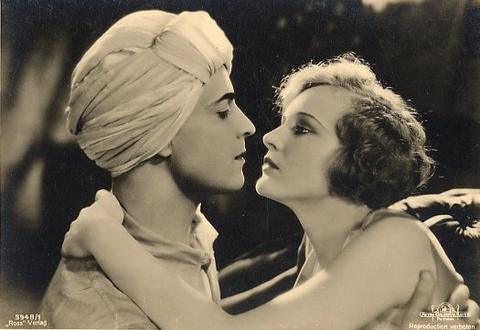
Showing posts with label ramon novarro. Show all posts
Monday, December 17, 2012
Pre-Code: Son of India(1931).
Son of India(1931). A romance film directed by Jacques Feyder. The film is based on the 1882 novel Mr. Issacs written by Francis Marion Crawford. Cast:Ramon Novarro, Conrad Nagel and Madge Evans.
On their long journey across India, Indian jewel trader named Hamid, whose life has not been an easy one and his son Karim, stop their caravan at an Indian village, where they plan to spend the night. There Hamid, tells his son that gratitude is the most important virtue one can possess. He then gives Karim his most precious possession, a large diamond.
Later, Karim meets Rao Rama, an old holy man, who saves his life by hiding him in a shallow grave when a gang of bandits, massacre the entire village, including his father, Hamid.
Now Karim, has to fend for himself on his travels to Bombay, where he tries to sell the diamond in a jewelry store. The jeweler tries to cheat Karim, by offering him only twenty rupee for the gem. When Karim tries to leaves the store, the merchant calls him a thief and has him arrested.
Things look pretty grim for Karim, until his luck changes, when a wealthy American named William Darsay, overhears the trial and steps forward as a witness to the fact that the jewel belonged to Karim.
Karim, is found innocent and his diamond is returned to him.
Later, when Karim finds William dining in his hotel, he tries to thank him by giving him the diamond, but the American refuses to accept it. Karim, then tells the kind William, that if he will not accept the gift, he must remain forever indebted to him.
While leaving the hotel, Karim is stopped by a wealthy man, who offers him a a lot of money for the diamond, which he accepts. Karim, is now a wealthy merchant.
Many years later while, at a polo match, he meets and falls in love with Williams sister, Janice Darsay.
Later, while visiting Karim at his mansion, Janice is called away by her aunt, who insists that she see William, in Calcutta. Janice, soon realizes her aunt's feelings about her relationship with Karim, when she tells her how she feels about her dating an Indian. Despite her aunt's wishes, Janice goes on a tiger hunt with Karim. Her aunt, then sends a message to William, telling him to come at once to save his sister.
While on their tiger hunt Karim, crosses paths with the bandit who killed his father and during their fight, Janice falls into a poisoned plant and is wounded. After Karim, removes the poison from Janice, the two become engaged.
When William arrives, he is surprised to see that Karim is the Indian with whom his sister is in love with. Even though William likes Karim, he asks him to call off the wedding, because an interracial marriage will ostracize Janice from her friends and family. Will Karim and Janice break off their engagement?
Son of India is a pre-code film starring one of the great actors of silent films, Ramon Novarro. The movie will hold your interest even though it is a very predictable love story. A must see if you are a Ramon Novarro, fan.
Madge Evans (July 1, 1909 – April 26, 1981). Was featured in print ads as the 'Fairy Soap girl' as an infant. She made her professional debut at the age of six months, posing for artist's models.
When she was four years old, Evans was featured in a series of child plays produced by William A. Brady. She worked at the old Long Island, New York movie studio.
Evans posed in a mother and child tableau with Anita Stewart, then 16, for an Anheuser-Busch Brewing Company calendar, and as the little mountain girl in Heidi of the Alps.
At the age of 8 in 1917, Evans appeared in the Broadway production of Peter Ibbetson with John Barrymore, Constance Collier and Laura Hope Crews.
At 17, she returned to the stage and appeared as Daisy Mayme. Some of her best work in plays came in productions of Dread, The Marquis, and The Conquering Male.
Her last appearance was in Philip Goes Forth produced by George Kelley.
Evans' mother took her to England and Europe when she was 15. As a child film actress, Evans had quite a prolific career appearing in dozens of films. She appeared with Marguerite Clark in: The Seven Sisters (1915), a film with a large female cast that had been played on stage with Clark's rival Mary Pickford and Laurette Taylor.
She was featured with Robert Warwick in, Alias Jimmy Valentine (1915). At 14, she stared in, On the Banks of the Wabash (1923). She co-starred with Richard Barthelmess in, Classmates (1924). She was working on stage when she signed with Metro Goldwyn Mayer in 1927.
Working for MGM in the 1930s, she performed in, Dinner at Eight (1933), Broadway to Hollywood (1933), Hell Below (1933), and David Copperfield (1935). In 1933, she starred with James Cagney in, The Mayor of Hell.
Other notable movies in which she performed: Beauty for Sale (1933), Grand Canary (1934), What Every Woman Knows (1934), and Pennies From Heaven (1936).
In 1939, she married playwright Sidney Kingsley, best known for his plays Dead End and Detective Story which were later turned into popular films. The couple owned a 50-acre estate two miles from Oakland, New Jersey.
Following her marriage to Kingsley, Evans left Hollywood and moved to the New Jersey home.
Later, she worked in radio and television in New York City. Evans performed on the Philco Television Playhouse (1949–1950), Studio One (1954), Matinee Theater (1955), and The Alcoa Hour (1956). She refused repeated offers to return to Hollywood. She retired in 1971. Madge Evans died at her home in Oakland, New Jersey from cancer in 1981, aged 71.
Friday, August 10, 2012
Pre-Code: Mata Hari(1931).
Mata Hari(1931). A Pre-Code film loosely based on the life of Mata Hari (the stage name of Margaretha Geertruida Zelle), an exotic dancer/courtesan executed for espionage during World War I. The film stars Greta Garbo in the title role. The film is credited with popularizing the legend of Mata Hari. The third and final film in which Ramon Novarro and Lewis Stone both appeared, though they have no scenes together.
During World War I, after the execution of a group of convicted spies, Dubois, chief of the French Spy Bureau, vows that he will someday find enough evidence to prosecute France's greatest enemy, Mata Hari, a famous dancer, who lives a double life as a German spy.
Mata, receives her assignments from a man named Andriani, who wants her to use her charms to learn more about the secret messages and maps detailing Russian troop movements, from the French and Russian officers.
Soon after meeting Lieutenant Alexis Rosanoff of the Russian Imperial Air Force, a flier who was had a successful flight over German lines to bring back a secret message, Mata begins an affair and falls in love with him. At first Mata, does not know that Alexis has the secret documents she has been ordered to steal.
Later, when Mata learns that Alexis is carrying the secret documents, she sleeps with him and darkens the apartment so that her fellow agents can take the papers, copy them and return them before anybody notices. Andriani, has Carlotta, one of his spies, killed for falling in love on the job. He then tells Mata that she must continue her relationship with Alexis.
Looking for a way to find the evidence he needs against Mata, Dubois tells her ex-lover General Shubin, that Mata has been having an affair with Alexis, hoping out of jealousy he will expose her treachery.
Shubin, does confront Mata, and Mata tries to prove that she does not love Alexis by showing Shubin the secret photographs she stole from the lieutenant. Not believing her, Shubin calls the embassy to have Mata arrested, but Mata shoots him so she can get away.
As Mata, leaves the murder scene, Andriani tells her that her Paris assignment is over and that she must now go to Amsterdam . Andriani, also informs her that Alexis has been injured in an airplane crash and has been hospitalized. He then forbids her to visit Alexis, Mata resigns so she can be with Alexis. At his bedside, Mata promises the blinded Alexis that she will never leave him. As soon as Mata leaves the hospital, she is arrested by Dubois and put on trial for murder and espionage.Will she be able to prevent Alexis from ever knowing about her crimes and avoid execution?
I really enjoyed this dramatic love story and thought Great Garbo, looked beautiful performing the exciting role as a double agent.
Karen Morley (December 12, 1909 – March 8, 2003). After working at the Pasadena Playhouse, she came to the attention of the director Clarence Brown when he was looking for an actress to stand-in for Greta Garbo in screen tests.
This led to a contract with MGM and roles in such films as Mata Hari (1931), Scarface (1932), The Phantom of Crestwood (1932), The Mask of Fu Manchu (1932), Arsene Lupin (1933) and Dinner at Eight (1933).
In 1934, Morley left MGM after arguments about her roles and her private life. Her first film after leaving MGM was Our Daily Bread (1934), directed by King Vidor. She continued to work as a freelance performer, and appeared in Michael Curtiz's Black Fury, and The Littlest Rebel with Shirley Temple.
Without the support of a studio, her roles became less frequent, however she played a supporting role in Pride and Prejudice (1940). Her career came to an end in 1947, when she testified before the House Un-American Activities Committee and refused to answer questions about her alleged American Communist Party membership. She maintained her political activism for the rest of her life. In 1954, she ran unsuccessfully for Lieutenant Governor of New York on the American Labor Party ticket. After being blacklisted in Hollywood by the studio bosses, she was never able to rebuild her acting career. In December 1999, at the age of 90, she appeared in the magazine Vanity Fair in an article about blacklist survivors.
Tuesday, July 12, 2011
“The Flying Fleet “ (1929)

“The Flying Fleet “ (1929) is a silent drama starring Ramon Novarro, Ralph Graves, and Anita Page. Directed by George Hill, this film features excellent footage of naval aircraft. The story begins with six graduating seniors at the U.S. Naval Academy on the eve of their graduation. The six have been the best of friends for four years, and all of them are hopeful flyboys, but only two, Lt. Tommy Winslow, played by Ramon Novarro, and Lt. Steve Randall, played by Ralph Graves, complete the program. Unfortunately, they become romantic rivals when they fall in love with the same girl, Anita Hastings, played by Anita Page.

I think “The Flying Fleet” is a very good film. Ramon Novarro and Ralph Graves deliver great performances as hopeful flyboys and romantic rivals. The 18 year old Anita Page looks lovely and gives a charming performance as the love interest of the two buddies. This film depicted naval flight training in a very authentic way. I liked the way synchronized sound effects and music were added to this otherwise silent film. A box office hit, “The Flying Fleet” is a late MGM silent that is worth watching, especially for those that love old aircrafts.

Anita Page was born Anita Pomares on August 4, 1910, in Queens, New York. Her father’s side of the family was from El Salvador of Spanish ancestry. Her entrance into films came courtesy of her friend, actress Betty Bronson. Betty’s mother put one of Anita’s photos in her home, and a man who was handling Betty’s fan mail saw it and said he was going into the business of handling stars. Anita called him, and he told her to be at the front gate of Paramount at 9:00 the next morning and to bring the picture. The casting director took one look at the picture and gave Anita a test. MGM was also interested. Anita was put through the dilemma of having to choose between MGM and Paramount contracts. She decided to take the MGM contract. Anita’s first MGM film was “Telling the World” (1927) with William Haines. Another early role was “While the City Sleeps” (1928) as Lon Chaney’s love interest. Anita’s biggest break was “Our Dancing Daughters” (1928) with Joan Crawford and Johnny Mack Brown. Anita made two more films with Joan Crawford, “Our Modern Maidens” (1929) and “Our Blushing Brides” (1930). In 1929, Anita appeared in two talkies, “The Hollywood Revue” and the Academy Award-winning “The Broadway Melody.” From about 1930 on, MGM began to lose interest in Anita’s career. Anita had admired the way Louis B. Mayer, studio head at MGM, groomed stars if he liked them and remained in his favor. However, when Mayer tried to get her into bed, that is when Anita drew the line. She liked him as a boss, but that is where it ended. In 1934, Anita wed songwriter Nacio Herb Brown, who had dedicated the song “You Were Meant for Me” to her. They never lived together because Anita said they were not married in the Catholic church. After nine months of marriage, Anita found out he was still married to his previous wife, so Anita had their marriage annulled. In 1937, Anita did marry in church, to a handsome naval officer named Herschel House. They were married fifty-four years until House died in 1992. The couple had two daughters.
Anita had many fond memories of her career, and thought she was blessed to have worked with so many of the greats like Lon Chaney, Buster Keaton, John Gilbert, William Haines, Clark Gable and Ramon Novarro, her favorite leading man. Anita Page died on September 6, 2008 of natural causes. She was 98 years old.
Monday, April 18, 2011
“The Pagan” (1929)

“The Pagan” (1929) is a silent romantic drama starring Ramon Novarro, Renee Adoree, Donald Crisp, and Dorothy Janis. Directed by W.S. Van Dyke, this film gave Hollywood one of its first hit tunes.
In this film, Ramon Novarro plays Henry Shoesmith, Jr., the son of a white father and Polynesian mother who owns the largest cocoanut plantation in Tahiti. Henry is a wealthy man that would rather spend his time lounging in the sun than conducting business. He meets a beautiful girl named Tito, played by Dorothy Janis, who is also half white half Polynesian like himself. Henry and Tito fall in love and want to get married, but Tito’s guardian, Roger Slater, played by Donald Crisp, is consumed with lust for her and hates Henry.

“The Pagan” (1929) is a beautifully made film that helped propel Ramon Novarro into the talkies and his fine tenor turned Nacio Herb Brown and Arthur Freed’s “The Pagan Love Song” into a hot-selling Victrola sensation. “The Pagan” was Novarro’s last silent film, and he gives one of his best performances. The supporting cast is excellent, especially Renee Adoree, who gives a moving performance as a prostitute with principles and who also loves Novarro. Donald Crisp is very effective as the lecherous Roger Slater, who has an eye for the beautiful and innocent Dorothy Janis. I liked how the film doesn’t attack religion, but the hypocrisy portrayed by the villain who hides his lust as an act of Christian charity.
Superbly shot in Tahiti and with synchronized score, “The Pagan” is a visually stunning film which showcases Novarro’s fine singing voice.

Ramon Novarro was born Jose Ramon Gil Samaniegos on February 6, 1899 in Durango, Mexico. The son of a prosperous dentist, Novarro came to Los Angeles in 1915, at the age of sixteen, hoping to make music his life’s work. His first years in Hollywood were difficult; he had to work at a variety of odd jobs to make ends meet. He appeared as an extra in more than one hundred films before he got his first credited role in “Mr. Barnes of New York” (1922), under the name of Ramon Samaniegos. By the time he made “The Prisoner of Zenda” later that year, with his mentor and lifelong friend, Rex Ingram, he was working as Ramon Novarro. By 1923, Novarro was receiving 1,300 fan letters a week. By the time his next picture, “Scaramouche,” was released later that year, he was being described as a matinee idol, and his success was said to earn him a million dollars a year. His popularity extended throughout the world, and he often had to travel in disguise in Europe and elsewhere. Novarro was not just a pretty face. He was involved in the purchase and development of real estate. Fluent in Spanish, English, French and Italian, he enjoyed reading, travel, and the opera. He directed, acted in, and composed the music for the French and Spanish versions of “Call of the Flesh” (Le Chanteur de Seville 1930) and (La Sevillana 1931). Even though Novarro did play a number of roles as sheik and Latin lover, he was most recognized for his roles in other films including the epic, “Ben-Hur” (1925), in which he played a Jewish prince. Novarro never achieved the same heights of popularity in talking pictures, but he continued his career as a character actor in films and television. Novarro met a grisly and tragic end on October 30, 1968, when he was savagely murdered at his Hollywood Hills home by two men who sought to rob him of $5,000. Novarro was 69 years old.
Thursday, January 28, 2010
RAMON NOVARRO- Silent Film Star.


Born José Ramón Gil Samaniego in Durango, Mexico, he moved to Los Angeles, California to get away from the 1913 Mexican Revolution. Ramon, is second cousin of the Mexican actresses Dolores del Río and Andrea Palma, he began his career in films in 1917 playing bit parts, he also had to supplement his income by working as a singing waiter. Actor and director Rex Ingram and his wife, actress Alice Terry, promoted to him to rival Rudolph Valentino and had him change his name to "Novarro". His first major role was in Scaramouche(1923). In 1925, he achieved his greatest success in Ben-Hur. With Valentino's death in 1926, he became one of the screen's leading Latin actors, just below John Gilbert. He performed in many swashbuckler action roles, and was also thought of as one of the great romantic lead actors of his day. Novarro appeared with Norma Shearer in The Student Prince in Old Heidelberg (1927) and performed with Joan Crawford in Across to Singapore in 1928. He made his first talking film, starring as a singing French soldier, in Devil-May-Care (1929). Novarro performed with Greta Garbo in Mata Hari (1932) and played opposite Myrna Loy in The Barbarian (1933).
LIST OF RAMON NOVARRO FILMS:
Crisis (1950)
The Outriders (1950)
The Big Steal (1949)
We Were Strangers (1949)
La Virgen que forjó una patria (1942)
La Comédie du bonheur (1940)
A Desperate Adventure(1938)
The Sheik Steps Out (1937)
Contra la corriente (1936)
The Night Is Young(1935)
Laughing Boy (1934)
The Cat and the Fiddle (1934)
The Barbarian (1933)
Huddle (1932)
The Son-Daughter (1932)
The Christmas Party (1931)
Mata Hari (1931)
Son of India(1931)
Daybreak(1931)
Chanteur de Séville, Le (1930)
Sevilla de mis amores (1930)
Call of the Flesh (1930)
In Gay Madrid (1930)
The Pagan (1929)
Devil-May-Care (1929)
The Flying Fleet(1929)
Forbidden Hours (1928)
A Certain Young Man (1928)
Across to Singapore (1928)
The Road to Romance (1927)
Student Prince in Old Heidelberg, The (1927)
Lovers?(1927)
Ben-Hur(1925)
The Midshipman (1925)
A Lover's Oath (1925)
The Red Lily (1924)
The Arab(1924)
Thy Name Is Woman (1924)
Scaramouche (1923)
Where the Pavement Ends (1923)
Trifling Women (1922)
The Prisoner of Zenda (1922)
Wednesday, January 27, 2010
Ramon Novarro "The Red Lily" (1924)

"The Red Lily" (1924) is a silent romantic drama that stars Ramon Novarro, Enid Bennett, and Wallace Beery. Directed by Fred Niblo, it is actually about a small town romance that turns tragic. The story begins in a small village in French Brittany where Jean Leonnec, played by Ramon Novarro, and Marise La Noue, played by Enid Bennett, are childhood sweethearts. When Marise's father dies suddenly they are torn apart. Impoverished and alone, Marise is sent to relatives who abuse her. She runs off seeking refuge in her old home where she meets up with Jean and they fall asleep in front of the fireplace together. The next morning the young lovers are confronted by gossipy townspeople and Jean's class conscious father who disowns him. Jean and Marise flee to Paris to start a new life together. Unfortunately, through circumstances, they are separated and spend years searching for one another. Jean and Marise's lives change drastically in the process. She is a prostitute known as "The Red Lily" and he teams up with a clever thief named Bo-Bo, played by Wallace Beery, and runs from the law.
r Marise, the police arrive to arrest him. Jean is imprisoned once again and Marise is left alone. Will Jean and Marise ever reunite? "The Red Lily" is a deeply moving film that encompasses the many trials and tribulations of love. The cinematography is quite breathtaking with its brightly tinted shades of sepia, red, and orange to convey a complexity of mood and emotion. The scenes of the Paris slums are full of villainous characters and appropriately gloomy. Under the superb direction of Fred Niblo, who was Enid Bennett's husband at the time, both Bennett and Novarro give remarkable performances. Bennett's transformation from a peasant girl to a prostitute demonstrates her skill as an actress. It is heartbreaking to see Novarro make the transition from a wholesome young man to a hardened thief. Even though Novarro was a screen idol in the Latin Lover category, he was highly celebrated for both his good looks and his acting ability. By the time he starred in "The Red Lily," Novarro had played leading roles in quality films such as "The Prisoner of Zenda" (1922) and "Scaramouche" (1923).Novarro would work often with
great directors, including not only Niblo but Rex Ingram, Ernst Lubitsch, and Jacques Feyder. Ironically, it was Niblo who directed Novarro in "Ben-Hur" (1925), the film that made him a major star. A largely forgotten gem of the silent era, "The Red Lily" is a deeply moving tale of fate, tragedy, and redemption.
When Jean and Marise finally meet again, they hardly recognize one another. Jean is shocked at Marise's degrading lifestyle and rejects her. When Jean is shot while avoiding the police, Marise nurses him back to health. However, Jean still spurns Marise and at his underground hangout he encourages the others to taunt her. Just as Jean experiences the last pangs of compassion foTHE RED LILY (1924) MOVIE CLIP.
MOVIE CLIP #2.
Subscribe to:
Posts (Atom)