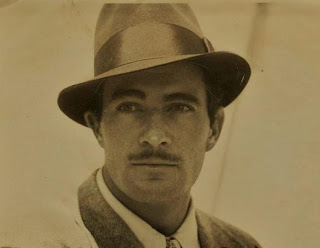
Showing posts with label gilbert roland. Show all posts
Thursday, March 28, 2013
After Tonight (1933).
After Tonight (1933). World War I spy film directed by George Archainbaud. The studio considered firing Bennett after the film lost $100,000 at the box office. Cast: Constance Bennett, Gilbert Roland , Edward Ellis, Sam Godfrey, Lucien Prival, Mischa Auer. Bennett sings and does a fan dance! She and Roland later married in real life.
The start of World War I, Carla is befriended by German officer Rudolph Ritter, who seems smitten with her, at the train station while buying a ticket to Vienna.
After the over crowed train drops them at the Austrian border and while her new friend is looking for a car, Carla, kisses him good by and leaves without explanation.
In Vienna, Rudolph's job is to break into a Russian spy ring, unaware that Carla, who is actually Russian, is passing and receiving messages in fake coins under the code name K-14 while posing as a cabaret singer dressed in feathers.
After Carla is searched and almost caught with a message during a performance, she is reassigned to a seamstress' shop. When her fellow spy is shot and killed and her cover is exposed, she flees Vienna one step ahead of Rudolph and becomes a nurse at a German military hospital under new orders. She holds up well while the war is going on right outside the hospitals doors.
Later, one of Carla's messages, which she has written in invisible ink in a book, is intercepted by Rudolph as it is being passed from one agent to another.
Rudolph, travels to a German post and makes a promise that he will catch what is claimed to be the most intelligent spy so far.
They meet again and against her better judgment, they dine and dance and under the moonlight, Carla falls in love with her enemy. He finds evidence implicating her as the spy, after she is arrested while having her hair washed. Rudolph, is reluctant to admit that she is K-14. Forced by his sense of duty, Rudolph traps Carla by passing her a phony order, in the ear of a patient sent to the hospital, to meet a contact in a deserted cottage.
Finally caught by Rudolph, who was hoping something to happen to him to protect Carla, so he would not have to arrest her. As they are leaving, she is rescued by another spy dressed as a gypsy, who shoots and wounds Rudolph during the escape.
After the war is over, Rudolph and Carla meet again at a crowded Swiss train station after two years and are happy to find each other still alive.. they fall into each other's arms.
The film is very well made and the films fast pace, will hold your interest until the very end. The theme song of the film, which Bennett sings, is very sweet. This film may remind you of another spy film, Garbo's MATA HARI.
Virginia Weidler (March 21, 1927 – July 1, 1968) was a child actress, popular in Hollywood films during the 1930s and 1940s. Virginia Weidler made her first film appearance in 1933. Over the next few years, she was cast in minor roles for RKO and Paramount Pictures.
Neither studio made more extensive use of her and when Paramount did not extend her contract, she was signed by MGM in 1938. Her first film for MGM was with their leading male star Mickey Rooney in Love Is a Headache (1938). The film was a success and Weidler was now cast in larger roles, most often as precocious tom-boys.
She was one of the all-female cast of the 1939 film The Women, as Norma Shearer's daughter.
Her next major success was The Philadelphia Story (1940) in which she played Dinah Lord, the witty younger sister of Tracy Lord (Katharine Hepburn).
As a teenager she was less popular with audiences. After a string of box-office disappointments, her film career ended with the 1943 film Best Foot Forward.
At her retirement by age 17, she had appeared in more than forty films, and had acted with some of the biggest stars day: Clark Gable and Myrna Loy in Too Hot to Handle, Bette Davis in All This and Heaven Too and Judy Garland in Babes on Broadway.
On March 27, 1947, Weidler married Lionel Krisel. They had two sons, Ronnie and Gary. Her older brother, saxophonist George Weidler (01/11/1926 – 12/27/1989) was married to Doris Day from March 1946 to May 1949.
Weidler refused to be interviewed for the remainder of her life, living in private. She remained married to Krisel until her death on July 1, 1968 when she suffered a heart attack in Los Angeles at age 41.
Monday, July 30, 2012
A Tribute to Gilbert Roland
Born Luis Antonio Damaso Alonso, in Juarez, Mexico on
December 11, 1905, to Spanish-born parents, Gilbert Roland’s career spanned
over sixty years from silent films to his last screen appearance in “Barbarosa” (1982).
Gilbert’s father moved the family to El Paso, Texas when
Gilbert was a child, in response to Pancho Villa’s threat to the lives of all
Mexicans of Spanish descent. The Alonsos had been bullfighters for generations,
and as a child Gilbert had worked in his father’s bullring in Juarez.
Gilbert grew up in the barrios of El Paso, selling
newspapers in front of a hotel. As a teenager he hopped a freight train and
made his way to Los Angeles to break into movies.
After a few years of working at whatever job he could find, Gilbert
found work as an extra in countless movies, including “Blood and Sand” (1922)
and “The Phantom of the Opera”(1925).
Gilbert was actually discovered in a mob scene by agent Ivan
Kahn, and was signed for the second lead in “The Plastic Age” (1925) with Clara
Bow. At age nineteen, Gilbert chose his screen name by combining those of his
two favorites, John Gilbert and Ruth Roland. Gilbert attained stardom with
Camille (1926) opposite Norma Talmadge. Gilbert was also the leading man in
numerous silents like “Rose of the Golden West” (1927) with Mary Astor, “The
Love Mart” (1927) with Billie Dove, and “New York Nights” (1929) with Norma
Talmadge.
Although Gilbert was one of the few actors to survive the
transition from silent to sound films, his career as a leading man waned in the
early 1930’s. Some of the films Gilbert appeared during the 1930’s and 1940’s
include “Life Begins” (1932), “A Parisian Romance” (1932), “Call Her Savage”
(1932), “She Done Him Wrong” (1933), “After Tonight” (1933), "The Last Train from Madrid" (1937), "The Sea Hawk”
(1940) and “Angels with Broken Wings” (1941).
Gilbert enlisted in the United States Army during World War
II. After the war, he starred in a series of popular Cisco Kid films at
Monogram Studios. In 1949, his career took an upward turn when director John
Huston picked Gilbert to play a cynical Cuban revolutionary in “We Were
Strangers” (1949) with John Garfield and Jennifer Jones. The picture wasn’t a
success, but the critics in New York gave him wonderful notices.
In 1950, Gilbert appeared in “Crisis” (1950) opposite Cary
Grant, Ramon Novarro and Antonio Moreno. Gilbert gave a moving and much talked
about performance as an aging bull fighter in “The Bull Fighter and the Lady”
(1951) and played a Latin Lover in “The Bad and the Beautiful” (1952). Some of
Gilbert’s other films from the 1950’s are “The Miracle of Our Lady of Fatima”
(1952), “Glory Alley” (1952), “The Diamond Queen” (1953), “The French Line”
(1954), “Underwater” (1955), and “Around the World in Eighty Days” (1956).
In the 1960’s, Gilbert had a featured role in John Ford’s
“Cheyenne Autumn” (1964). He went to Italy and made several spaghetti Westerns.
Some of Gilbert’s films from this period include “Guns of the Timberland”
(1960), “Samar” (1962) and “Any Gun Can Play” (1968).
Even though Gilbert played a wide variety of roles, he is
best remembered as a Latin Lover. However, he distinguished between the tough
Latin Lover and his own more sentimental personality. For example, Gilbert
carried in his pocket a picture of a gray-haired teacher that taught him to
speak English in El Paso, and the gold ring he always wore was given to him by
his mother. He also fought the industry’s tendency to stereotype Mexicans, and
although he had been born in Mexico, Gilbert considered himself a Spaniard.
Sunday, January 24, 2010
GILBERT ROLAND- Silent film star.

Gilbert Roland, Mexican born film actor. Mexico wanted him to become a bullfighter like his father. When the family moved to the United States. Gilbert wanting to be an actor landed is his first job working as an extra. He picked his screen name by combining the names of his favorite actors, John Gilbet and Ruth Roland. He was often cast in the "Latin Lover" role. Roland at the age of 19, first major performance was one of Clara Bow's love interests in the comedy The Plastic Age (1925). In 1927, he performed in Camille opposite Norma Talmadge, who he was romantically involved with. He starred opposite Talmadge in several films, until sound ended her career. He starred in several Spanish language adaptations of American films and continued as a romantic lead. In the 1940s, he was praised for his supporting roles in John Huston's We Were Strangers (1949), The Bad and the Beautiful (1952), Thunder Bay(1953), and Cheyenne Autumn (1964). He also performed in films in the mid 1940s as the character "The Cisco Kid". He played Hugo, the friend of the three shepherd children in The Miracle of Our Lady of Fatima, based on the apparitions of Our Lady of Fatima in 1917. 1953 he starred in the epic Beneath the 12-Mile Reef. His last film performance was in the (1982) Western Barbarosa.
Saturday, January 23, 2010
Clara Bow "The Plastic Age" (1925)

"The Plastic Age" (1925) is a silent romantic comedy starring Clara Bow, Donald Keith, and Gilbert Roland. Directed by Wesley Ruggles and adapted from the novel by Percy Marks, this film is a portrayal of college youth during the Jazz Age. The story begins with Hugh Carver, played by Donald Keith, a high school athletic star, going off to Prescott College. Before he leaves home, his father explains sex to him, but Hugh looks confused. When he arrives at Prescott College, Hugh is shocked to know that his roommate Carl Peters, played by Gilbert Roland, is quite the ladies man and party animal. With little or no experience with girls, Hugh encounters the "hotsy-totsy" Cynthia Day, played by Clara Bow, while invading a sorority house during his freshman hazing. Inflamed by hormones, Hugh decides to start smoking. When the 440 yard race comes up, he comes in dead last
.
When Hugh's parents visit the campus, his father tells him not to return home until he "has made good." Hugh doesn't seem to care. Cynthia has become his first priority in life and he is deep into the party scene. This causes a fight between Hugh and Carl, ending their friendship. Realizing that her partying lifestyle is hurting Hugh, Cynthia tells him they can't see each other any more. "The Plastic Age" was a huge hit. Even though Clara Bow had appeared in more than two dozen films up to that time, it is this film that is credited with elevating her to the ranks of superstardom. Bow's performance and on-screen magnetism rather than the story line accomplished this feat. However, the film was released at the height of the flapper age so the timing was perfect. Bow expresses the youthful energy and playfulness that made her an icon of the era. Bow's Cynthia Day is Betty Boop in the flesh. With her bobbed hair, big eyes, and boop-a-doop personality, she is so cute and lovable. Every time she comes on the screen she lights up everything around her. It is clearly hinted that Cynthia is a playful sexual aggressor, but she is virtuous enough. Donald Keith is very credible in the role of Hugh Carver. His infatuation with Cynthia comes across quite well. A nineteen year old Luis Antonio Damaso Alonso, who was renamed Gilbert Roland, was signed for the second lead as Car
l Peters. Roland's physical appearance certainly fits the role of the handsome college man. Fans of Clark Gable may find the film worthwhile just for taking a glimpse of him in several scenes as an athlete. Although "It" was the film that sparked Bow's nickname, "The Plastic Age" was the one in which she played her first flapper and made the role her own.
THE PLASTIC AGE (1925) MOVIE CLIP.
.
When Hugh's parents visit the campus, his father tells him not to return home until he "has made good." Hugh doesn't seem to care. Cynthia has become his first priority in life and he is deep into the party scene. This causes a fight between Hugh and Carl, ending their friendship. Realizing that her partying lifestyle is hurting Hugh, Cynthia tells him they can't see each other any more. "The Plastic Age" was a huge hit. Even though Clara Bow had appeared in more than two dozen films up to that time, it is this film that is credited with elevating her to the ranks of superstardom. Bow's performance and on-screen magnetism rather than the story line accomplished this feat. However, the film was released at the height of the flapper age so the timing was perfect. Bow expresses the youthful energy and playfulness that made her an icon of the era. Bow's Cynthia Day is Betty Boop in the flesh. With her bobbed hair, big eyes, and boop-a-doop personality, she is so cute and lovable. Every time she comes on the screen she lights up everything around her. It is clearly hinted that Cynthia is a playful sexual aggressor, but she is virtuous enough. Donald Keith is very credible in the role of Hugh Carver. His infatuation with Cynthia comes across quite well. A nineteen year old Luis Antonio Damaso Alonso, who was renamed Gilbert Roland, was signed for the second lead as Car
l Peters. Roland's physical appearance certainly fits the role of the handsome college man. Fans of Clark Gable may find the film worthwhile just for taking a glimpse of him in several scenes as an athlete. Although "It" was the film that sparked Bow's nickname, "The Plastic Age" was the one in which she played her first flapper and made the role her own. THE PLASTIC AGE (1925) MOVIE CLIP.
Subscribe to:
Posts (Atom)