Bardelys the Magnificent (1926). A Romantic silent film directed by King Vidor. Cast: John Gilbert and Eleanor Boardman. The film is based on a novel by Rafael Sabatini. It was the second film of the 19 year old John Wayne, who had a small role.
King Louis XIII sends Chatellerault to romance Roxalanne de Lavedan, hoping to keep the girl's fortune within the family. When Chatellerault says that Roxalanne is unapproachable, Bardelys, bets his entire estate that he will win her heart in three months time.
While traveling, Bardelys finds a dying man along the way and is given some letters with the name Lesperon, whose identity he uses as his own. Finding that Lesperon is a traitor, he looks for shelter in the Lavedan estate and he begins courting her.
Video: The river scene in the willows is romantic and beautiful.
St. Eustache, warns her that Lesperon is engaged to Mademoiselle Mersac and Bardelys is arrested for treason. Will the king arrive in time to save him from execution?
John Gilbert and Eleanor Boardman make a wonderful on screen couple. Loved the the opening duel scene, the river seen among the willows and the great closeups of Gilbert as he swings on tapestries. I tried to find John Wayne as an extra, with no luck...
Eleanor Boardman (August 19, 1898 – December 12, 1991), was originally on stage but, after temporarily losing her voice, she acted in silent films.
After, Rupert Hughes saw her riding a horse, he gave her a part in a film and she quickly became popular.
She was Goldwyn Pictures "New Face of 1922." After many supporting roles, she played the lead in, Souls for Sale(1923).
Her best known film was, The Crowd(1928), which is recognized as one of the best performances in American silent films.
Unable to make the transition from silent to talking pictures, Boardman retired in 1935.
Boardman was married to the film director King Vidor, with whom she had two daughters, Antonia (born 1927) and Belinda (born 1930). Their marriage lasted from 1926 until 1931. Fellow actors John Gilbert and Greta Garbo had planned a double wedding with them, but Garbo broke off the plans at the last minute.
Boardman's second husband was Harry d'Abbadie d'Arrast to whom she was married from 1940 until his death in 1968.
Boardman died in Santa Barbara, California at the age of 93.
Video: As it's raining heavily, the young husband and wife do not seem to worried about it at first. But, the husband gets soaked on the way home from work and when he finds that the butler has left all of his suits hanging outside in the rain, their troubles have just begun.
The Letter (1929), is a drama film which was made in both silent and talking versions by Paramount Pictures. Cast: Jeanne Eagels, O.P. Heggie, Reginald Owen and Herbert Marshall, and was directed by Jean de Limur. Eagels was posthumously put "under consideration" for nomination for the Academy Award for Best Actress for her portrayal of the married woman. She was the first performer to be so recognized by the Academy after her death.
Bette Davis was later to receive an Oscar nomination for playing the same role in William Wyler's 1940 remake. Herbert Marshall appeared also in the later film, this time as the husband.
The story begins when the Crosbie's, are marooned on a rubber plantation in the East Indies. Leslie Crosbie begins an affair with Geoffrey Hammond, looking for the love that her husband does not give to her.
Her lover Hammond, falls in love with a Chinese woman and out of jealously, Leslie shoots and kills him.
Placed on trial for her lovers death, Leslie convinces both the jury and her husband that she killed Hammond in self defense. The Chinese woman has an incriminating letter written by Leslie to Hammond and demands Leslie to pay $10,000 to get back her letter. Will her husband continue to stand beside her after reading the letter?
I just finished viewing this version of the classic film, The Letter. I'm so glad that Lady Eve, recommended this movie. I would have been very disappointed if I had missed seeing it.. I was really looking forward to seeing Jeanne Eagels, perform. The film is very good, and I think it is worth seeing, but.. it does not have the wonderful chemotherapy and lighting as the 1940's version. Although.. The scene where Jeanne's character travels to the East Indies town, to buy back her letter, is beautiful and full of suspense. Jeanne's performance was good, but.. she spoke in a rushed and some what jerky manner. I was very surprised at the ending.. If I were to pick between the two versions the 1940's version is my favorite.
Jeanne Eagels (June 26, 1890 – October 3, 1929) began her acting career in Kansas City, appearing in a variety of small venues at a very young age.
She left Kansas City around the age of 15 and toured the Midwest with the Dubinsky Brothers' traveling theater show. At first, she was a dancer, but in time she went on to play the leading lady in several comedies and dramas.
She married Morris Dubinsky, who frequently played villain roles.
Around 1911, she moved to New York City, working in chorus lines and eventually becoming a Ziegfeld Girl. Her hair was brown, but she bleached it when she went to New York. During this period, one of her acting coaches was Beverly Sitgreaves.
Eagels was in the supporting cast of, Mind The Paint Girl at the Lyceum Theatre in September 1912. Eagels played opposite George Arliss in three plays in 1916 and 1917.
In 1915, she appeared in her first motion picture. She also made three films for Thanhouser Film Corporation in 1916-17.
In 1918, she performed in Daddies. She quit this show due to illness and then traveled to Europe.
She made her first performance as a star in the play Rain, by John Colton, based on a short story by W. Somerset Maugham. Eagels played her favorite role, that of Sadie Thompson, a free-loving spirit who confronts a fire-and-brimstone preacher on a South Pacific island. She went on tour with Rain for two more seasons, and returned to Broadway to give a farewell performance in 1926.
In 1925, Eagels married Edward Harris "Ted" Coy, a former Yale University football star turned stockbroker. They had no children and divorced in 1928.
In 1926, Eagels was offered the part of Roxie Hart in, Maurine Dallas Watkins's play Chicago, but Eagels walked out of this role during rehearsals. She next performed in the comedy, Her Cardboard Lover (1927), in which she appeared on stage with Leslie Howard. She then went on tour with Her Cardboard Lover for several months. After missing some performances due to ptomaine poisoning, Eagels returned to the cast in July 1927 for an Empire Theater show.
After a season on Broadway, she took a break to make a movie. She appeared opposite John Gilbert in the MGM film Man, Woman and Sin (1927), directed by Monta Bell.
In 1928, after failing to appear for a performance in Milwaukee, Wisconsin, Eagels was banned by Actors Equity from appearing on stage for 18 months. The ban did not stop Eagels from working in film, and she made two "talkies" for Paramount Pictures, including The Letter and Jealousy (both released in 1929).
Just before she was to return to the Broadway stage in a new play, Eagels died suddenly in a private hospital in New York City on October 3, 1929 at the age of 39. Medical examiners disagreed on the cause of death there were three separate coroner's reports, all reaching different conclusions but the available evidence pointed to the effects of alcohol, a tranquilizer, or heroin. After services in New York, Eagels received a second funeral service when her body was returned to Kansas City, where she was buried in Calvary Cemetery.
Eagels was posthumously nominated for the Academy Award for Best Actress for her role in The Letter, but the Oscar went to Mary Pickford for the film Coquette.
In 1957, a mostly fictionalized film biography entitled Jeanne Eagels was made by Columbia Pictures, starring Kim Novak as Eagels.
Our Modern Maidens(1929). A silent film directed by Jack Conway. Cast: Joan Crawford in her last silent film role, Rod La Rocque, Douglas Fairbanks, Jr., and Anita Page. Our Modern Maidens is the second of three film where Crawford and Page appear together. Fun Fact: Joan Crawford married co-star Douglas Fairbanks Jr. in a well orchestrated publicity event for the film.
The story begins during the "Jazz Age". Billie Brown and Gil Jordan, decide to secretly get married. To find Gil a diplomatic job in Paris, Billie, decides to trick Glenn Abbott, who falls in love with her, saying Gil is only a boy. While this is all going on Gil and Kentucky have an affair, which he regrets, telling her of his engagement to Billie. Kentucky, says she will never tell Billie, her best friend.
Soon After, Glenn gets Gil the job and their engagement is announced, enraging Glenn to the point he almost rapes Crawford. Billie and Gil, go ahead with their plans and get married in an elaborate wedding.
All is well.. until Billie discovers Gil's affair with Kentucky. Giving them good wishes, she leaves her husband.
Sometime later.. in France, she and Abbott meet again. Will, they find themselves back in each other arms?
This silent film has it all... Fast cars, jazz parties, a love quadrangle, great art deco sets.. a wonderful glimpse back in time..
Ann Harding (August 7, 1902 – September 1, 1981). In 1929, she made her film debut in Paris Bound, with Fredric March. A story about Jim Hutton and Mary Archer, who are happy to remain faithful to each other in spirit only.
They are married with the bride believing that each should be allowed to do do what they want to do. Among the wedding guests is the young composer Richard Parrish, who is also in love with the bride, and Noel Farley, who is in love with Jim.
After they have their first child, Jim travels to Europe on a business trip, Mary declines to accompany him. Noel, who owns a villa at Antibes, lures Jim into a rendezvous. Menawhile, Mary has an affair with Richard. Learning of Jim's rendezvous, she considers a Paris divorce so as to marry Richard. When Jim unexpectedly returns, he tells Mary of his affair with a French woman. Mary is devastated, for she would never believe that her husband would actually sleep with another woman. In the end their mutual love is confirmed, and they decide to adopt traditional marriage morals and remain monogamous.
Fun Facts:
In 1931, she was nominated for the Academy Award for Best Actress for, Holiday.
Harding, was RKO studio's 'answer' to MGM's superstar Norma Shearer.
Harding's second film was, Her Private Affair.
During this period, she was considered to be one of cinema's most beautiful women, with her long waist-length blonde hair as one of her most noted attributes.
Her films during her peak include: The Animal Kingdom, Peter Ibbetson, When Ladies Meet, The Flame Within, and Biography of a Bachelor Girl.
Harding, became stereotyped as the innocent, self-sacrificing young woman. She eventually quit making movies when she married the conductor, Werner Janssen in 1937. She later returned in 1942 to make the film, Eyes in the Night and to take secondary roles in other movies. In 1956, she again starred with Fredric March, this time in, The Man in the Gray Flannel Suit.
“The Kiss” (1929) is a silent romantic drama starring Greta Garbo, Conrad Nagel, Anders Randolf, and Lew Ayres. Directed by Jacques Feyder, this film was Garbo’s last silent film and Lew Ayres’ first major screen role.
In this film, Garbo plays Irene Guarry, a young woman unhappily married to an older man, Charles Guarry, played by Anders Randolf. Irene is in love with a young lawyer, Andre Dubail, played by Conrad Nagel. When Irene decides to stop seeing Andre, she starts spending her time with Pierre Lassalle, the son of her husband’s associate, played by Lew Ayres. When Pierre leaves for college, he begs Irene for a goodbye kiss, a gesture that leads to jealousy, death and an explosive murder trial.
I think what makes “The Kiss” a good film is the combination of Garbo’s acting and the fine cinematography. Under Feyder’s direction, Garbo was even more impressive than she was in her other silent films. I like the way she convincingly played the sympathetic, but no longer in love wife. I also liked the use of light and dark and the superb close-ups. Lew Ayres, whose distinguished career would include “All Quiet on the Western Front” and the Dr. Kildare movies, impresses in his first major screen role. Only 64 minutes in length, “The Kiss” is a good story of tortured romance with a bit of mystery.
Born Greta Lovisa Gustafsson on September 18, 1905, in Stockholm, Sweden, Garbo was brought to the United States by Swedish director Mauritz Stiller after Louis B. Mayer saw her in “Gosta Berlings saga” (1924) and found it exciting enough to sign both Garbo and Stiller to MGM contracts. In her first American film, “Torrent” (1926), Garbo dazzled audiences with her beauty and complex emotions. Her films with silent screen star John Gilbert and their offscreen romance made for big box office as well. One of her most provocative pairings with John Gilbert was “Flesh and the Devil” (1926). With the advent of talkies, Garbo’s career continued to rise and she was successful in “Anna Christie” (1930), “Grand Hotel” (1932), “ Anna Karenina” (1935), “Camille” (1936) and “Ninotchka” (1939). When “Two-Faced Woman” (1941) turned into a humiliating debacle, Garbo decided not to make another film until the time was right. That day never came. The secret of the success of Garbo is not that she lived too long or too short a space in years, but that she knew when to retire and how to fashion herself into a mysterious and reclusive figure. Garbo had one of the most flawless faces in film history, and she looks beautiful in the silent films.
“The Garden of Eden” (1928) is a silent romantic comedy starring Corinne Griffith, Louise Dresser and Charles Ray. Directed by Lewis Milestone, this film is nicely balanced between romance and comedy.
The story begins with a naïve young woman, Toni LeBrun, played by Corinne Griffith, who decides to pursue a career as an opera singer. One night, Toni sneaks out of her aunt and uncle’s house to catch a train for Budapest. She arrives alone in the big city and goes to the cabaret, Palais de Paris, to audition for a role. It is at the cabaret that Toni meets the wicked owner Madame Bauer, played by Maude George. She is a businesswoman who wants to pimp her out to Henry D’Avril, one of Bauer’s wealthy customers, played by Lowell Sherman. When Madame Bauer provides a private room for Toni and D’Avril, Toni refuses his advances, and Rosa, the wardrobe mistress, played by Louise Dresser, helps her escape and they are both fired. What Toni doesn’t know is that Rosa is a baroness whose husband was killed in the Great War. She works all year and when she gets her late husband’s pension, she lives in Monte Carlo until her money runs out and then returns to Budapest. When Rosa’s pension arrives, she legally adopts Toni and takes her on a Cinderella-like adventure where she is pursued by two men, Richard Dupont, played by Charles Ray, and Colonel Dupont, his uncle, played by Edward Martindel.
“The Garden of Eden” (1928) is a delightful romantic comedy. I was really impressed with the photography and Corinne Griffith’s graceful performance. Charles Ray, who had been a popular actor in the 1910’s under the direction of Thomas H. Ince, delivers a solid performance. What I liked most about the film were the scenes with Corinne Griffith and Louise Dresser. They were perfect foils for each other, and their faces were so expressive.
Corinne Griffith was born Corinne Mae Griffin in Texarkana, Texas on November 21, 1894. She was a leading lady with Vitagraph from 1916 to 1922, appearing in more than forty films. From Vitagraph, Corinne moved on to First National where she headed her own production unit and where she would remain until 1930, except for one film, “The Garden of Eden” (1928), released by United Artists. Of the more than twenty-five First National films, three stand out: “Black Oxen” (1924), “Lilies of the Field” (1924) and “The Divine Lady” (1929). Corinne did appear in a couple of 1929 features with sound sequences, followed by two complete talkies, “Lilies of the Field” and “Back Pay” in 1930. With those films, her First National contract ended and her film career was over. Corinne was married four times, first to her Vitagraph director Webster Campbell then to producer Walter Morosco. In 1936, she married George Marshall, owner of the Boston Braves, and became a baseball fan. Corinne wrote her experiences in a 1946 “Saturday Evening Post” article, “My Life with the Redskins.” It was the first of six books that Corinne was to author, including “Papa’s Delicate Condition (1952), which was filmed in 1963 as a vehicle for Jackie Gleason. Corinne divorced George Marshall in 1958, and in 1965, she married realtor and singer, Dan Scholl. He was 44 and she was 71. The couple separated after six weeks and the divorce proceedings were extraordinarily messy. At the time of her death, Corinne’s estate was valued at $150 million dollars. She was one of the wealthiest women in the world.
“The Flying Fleet “ (1929) is a silent drama starring Ramon Novarro, Ralph Graves, and Anita Page. Directed by George Hill, this film features excellent footage of naval aircraft. The story begins with six graduating seniors at the U.S. Naval Academy on the eve of their graduation. The six have been the best of friends for four years, and all of them are hopeful flyboys, but only two, Lt. Tommy Winslow, played by Ramon Novarro, and Lt. Steve Randall, played by Ralph Graves, complete the program. Unfortunately, they become romantic rivals when they fall in love with the same girl, Anita Hastings, played by Anita Page.
I think “The Flying Fleet” is a very good film. Ramon Novarro and Ralph Graves deliver great performances as hopeful flyboys and romantic rivals. The 18 year old Anita Page looks lovely and gives a charming performance as the love interest of the two buddies. This film depicted naval flight training in a very authentic way. I liked the way synchronized sound effects and music were added to this otherwise silent film. A box office hit, “The Flying Fleet” is a late MGM silent that is worth watching, especially for those that love old aircrafts.
Anita Page was born Anita Pomares on August 4, 1910, in Queens, New York. Her father’s side of the family was from El Salvador of Spanish ancestry. Her entrance into films came courtesy of her friend, actress Betty Bronson. Betty’s mother put one of Anita’s photos in her home, and a man who was handling Betty’s fan mail saw it and said he was going into the business of handling stars. Anita called him, and he told her to be at the front gate of Paramount at 9:00 the next morning and to bring the picture. The casting director took one look at the picture and gave Anita a test. MGM was also interested. Anita was put through the dilemma of having to choose between MGM and Paramount contracts. She decided to take the MGM contract. Anita’s first MGM film was “Telling the World” (1927) with William Haines. Another early role was “While the City Sleeps” (1928) as Lon Chaney’s love interest. Anita’s biggest break was “Our Dancing Daughters” (1928) with Joan Crawford and Johnny Mack Brown. Anita made two more films with Joan Crawford, “Our Modern Maidens” (1929) and “Our Blushing Brides” (1930). In 1929, Anita appeared in two talkies, “The Hollywood Revue” and the Academy Award-winning “The Broadway Melody.” From about 1930 on, MGM began to lose interest in Anita’s career. Anita had admired the way Louis B. Mayer, studio head at MGM, groomed stars if he liked them and remained in his favor. However, when Mayer tried to get her into bed, that is when Anita drew the line. She liked him as a boss, but that is where it ended. In 1934, Anita wed songwriter Nacio Herb Brown, who had dedicated the song “You Were Meant for Me” to her. They never lived together because Anita said they were not married in the Catholic church. After nine months of marriage, Anita found out he was still married to his previous wife, so Anita had their marriage annulled. In 1937, Anita did marry in church, to a handsome naval officer named Herschel House. They were married fifty-four years until House died in 1992. The couple had two daughters.
Anita had many fond memories of her career, and thought she was blessed to have worked with so many of the greats like Lon Chaney, Buster Keaton, John Gilbert, William Haines, Clark Gable and Ramon Novarro, her favorite leading man. Anita Page died on September 6, 2008 of natural causes. She was 98 years old.
“Quality Street” (1927) is a silent comedy drama starring Marion Davies, Conrad Nagel and Helen Jerome Eddy. Based on the famous James M. Barrie play and directed by Sidney Franklin, “Quality Street” was a good showcase for Marion Davies. In this period story, Marion Davies plays Phoebe Throssel, a young woman who fails to land a proposal from her beloved, Dr. Valentine Brown, played by Conrad Nagel, before he leaves to the Napoleonic Wars. When he returns, Phoebe has become old and drab, and he is no longer interested in her. To punish him, Phoebe pretends to be her teenage niece Livvy in order to win him back.
Even though I’m not a big fan of costume dramas, I enjoyed this film mainly for the screen presence of Marion Davies. It was as a comedienne that Marion truly lit up the screen, and in this comedy of manners she is wonderful in the dual roles of Phoebe and Livvy. I think this silent version of “Quality Street” is terrific in its costumes, sets, and cinematography. I just wish there were more scenes where Marion could show off her comic skills. Although the film has some nitrate decomposition in some scenes, it shouldn’t deter from its enjoyment.
Marion Davies was born Marion Cecilia Douras to a large Brooklyn family on January 3, 1897. All three of her sisters went on the stage but, despite their beauty, never became big stars. The Douras family (soon stage-named Davies) moved to Manhattan and little Marion began finding the theater more fascinating than school. It was during her run in the 1917 “Follies” that she caught the eye of the married, powerful newspaper publisher William Randolph Hearst. It was life-long love at first sight for the fifty-four-year old Hearst. Within a few years, Marion was as dedicated to him as any wife could be. The legal Mrs. Hearst, however, refused him a divorce. Marion had made her film debut in “Runaway, Romany” (1917). The reviews were good, and Marion seemed well on her way to becoming another Mabel Normand, but then Hearst stepped in to guide her career. His taste ran to overblown period films. Ironically, Marion was a brilliant comedienne with limited dramatic skills.
In 1919, Hearst formed Cosmopolitan Pictures, a subsidiary of Paramount, through which the films were released. In 1924, Cosmopolitan changed the affiliation to Goldwyn, and thereby to MGM when the studios merged. Among Marion’s more successful costume dramas were “Little Old New York” (1923), “Lights of Old Broadway” (1925), “Beverly of Graustark” (1926), “The Red Mill” (1927), and “Quality Street” (1927). Later in the decade, Marion was given a few opportunities to show off her comic skills in films like “The Patsy” (1928) where she did hilarious imitations of Mae Murray, Lillian Gish and Pola Negri. In “Her Cardboard Lover” (1928), Marion did a wicked parody of costar Jetta Goudal. “Show People” (1928) was Marion’s finest hour. She showed great comic timing and the rare opportunity to poke fun at both herself and her profession.
Despite her slight stammer, Marion had nothing to fear from talkies. It was the quality of her scripts which gave her trouble. Hearst did fall out with Louis B. Mayer, and in 1934, Marion, Hearst, and Cosmopolitan moved to Warner Brothers. That studio dolled her up in stiff platinum-blonde wigs and starred her in four films. Only “Cain and Mabel” (1936) with Clark Gable really had any merit. Marion had enough and at the age of forty retired. She spent the next fourteen years as Hearst’s wife in all but name. Despite Hearst’s constant efforts to keep her away from liquor, Marion was an alcoholic. Her looks and health began to fade, but not her charm. After Hearst’s death in 1951, Marion quickly wed old friend Captain Horace Brown, more for companionship than for love. The marriage was a stormy one, but it endured. After suffering from jaw cancer for three years, Marion died on September 22, 1961. She was 64 years old.
It’s interesting to note that Marion’s beloved “niece,” Patricia van Cleve Lake, died in her early seventies on October 3, 1993, in California. Shortly thereafter, her son Arthur Lake, Jr. (son of the late actor Arthur Lake), announced that his mother was the daughter of Marion Davies and William Randolph Hearst, born in Paris sometime in the early 1920’s.
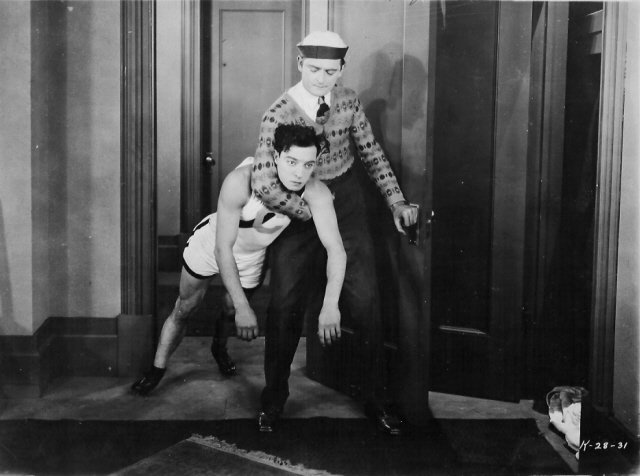
“College” (1927) is a silent comedy starring Buster Keaton, Anne Cornwall, and Flora Bramley. Directed by James W. Horne, this film stars Keaton in one of his most memorable roles as the hapless Ronald who gives a high school valedictory address that praises books and condemns sports. His girlfriend Mary thinks that’s nonsense. Afraid he might lose her, Ronald goes to college and tries to become a star athlete.
“College” is my favorite of Keaton’s silent comedies because the majority of the film’s gags concern Buster’s attempts to become a successful athlete in order to win back his girlfriend. It’s interesting to note that in 1927, before he began making films, Spanish director Luis Bunuel praised Keaton’s achievement in “College” for its simple cinematic style, and at least one segment in his classic surrealist film, Un Chien andalou (1929) may have been influenced by Keaton.
Buster Keaton, The Great Stone Face, was a filmmaker and comedian. He wrote, produced, directed and acted in ten feature length comedies within five years in the 1920’s. He was also in 124 other films, short and long, over a 50 year period right up to his death in 1966. He and his parents and two younger children were a close and happy family for his first twenty years. His father had met his mother while playing in her father’s medicine show, and Buster was born on tour, in Piqua, Kansas. His very earliest stunt was observed by the famous magician, Harry Houdini, a member of their vaudeville company. When six-month-old Joseph rolled down a flight of stairs at a theatrical boarding house and came up laughing, Houdini and Joseph, Sr. nicknamed him Buster. There were many happy tours and pleasant family summers, but eventually alcoholism caught up with Joseph Keaton, Sr. Mrs. Keaton broke up the act in 1917, and Buster got a job on his own with a new musical review on Broadway for $250 a week. Before Buster could start, he visited the set of a Roscoe Arbuckle film production on East 48th Street. Buster was invited to do a bit part in the two-reeler starting that day, “The Butcher Boy” (1917). Buster turned down the $250 for a chance to work in a medium for $40 a week to start. Buster worked with Arbuckle from 1917 to 1919. Joseph Schenck, who had been handling the finances for the Arbuckle films, decided to let young Buster Keaton produce a series of his own pictures. Schenck left Buster free to work as he pleased, but he kept ownership of the films. Keaton had trusted his brother-in-law, Schenck, to take care of his business affairs, but in 1928, Schenck advised him to give up his independence and go to work at MGM. This took away Keaton’s creative freedom and after two more pictures he began to suffer personally and professionally. Keaton did stay busy, but the declining years were bitter and degrading. His marriage in 1921 to Natalie Talmadge, whose sister Norma had married Schenck, started well and it lasted ten years, but Keaton was appalled at his wife’s financial demands. The divorce took much of Keaton’s property and income and separated him from his two sons. Keaton developed a problem with alcohol, but his desire to live pulled him out of it. One day in 1938, Keaton was playing bridge at his mother’s house with some friends and he met a 19-year-old girl who also liked bridge. Eleanor Norris liked this humorous man who was so interesting and so kind to her. After a long acquaintance, she encouraged him to marry her and she stayed with him until his death in 1966.
Keaton lived long enough to receive an enthusiastic ovation at the 1965 Venice Fim Festival, but he did not live long enough to accept honors and applause from the new audiences that have come along and embraced his comedic style.
“The Black Pirate” (1926) is a silent action drama starring Douglas Fairbanks, Billie Dove and Donald Crisp. Directed by Albert Parker and written by Douglas Fairbanks, this film is a particular favorite of many of Fairbanks’ loyal fans.
The story begins with a lot of treacherous pirates having just captured and looted another ship. They then tie their captives to the mast and use the powder to blow up the ship. However, a father and son, played by Douglas Fairbanks, escape. When the father dies, the son vows revenge on the murderers responsible for his father’s death. Becoming the Black Pirate, he joins the crew and becomes their leader. However, his plans for revenge become more complicated when he meets his first captive, Princess Isobel, a beautiful Spanish princess, played by Billie Dove.
“The Black Pirate” was a huge hit, receiving both critical raves and box office patronage. The film is greatly enhanced by its beautiful two-strip Technicolor photography. The underwater photography sequences were spectacular in their day, and are still highly effective. Fairbanks looks terrific in “The Black Pirate.” He is amazing, especially when he executes a grand stunt in which he slides down a ship’s sail. Fairbanks was an accomplished boxer, gymnast, fencer, and horse rider offscreen, and his onscreen stunts presented few problems. With its impressive stunts by Fairbanks, sword fights, a damsel in distress and a last minute rescue, this silent gem is definitely worth discovering.
Born Lillian Bohny,Billie Dove was born in New York City on May 4, 1903. Billie was an exceptional beauty, and her brown hair lightly streaked with gray added to the dramatic effect. In 1927, Billie starred in a feature titled “The American Beauty” and became known by the nickname. Billie worked as an extra at Fort Lee, New Jersey, before receiving her first screen credit, “Get-Rich-Quick-Wallingford” (1921) and came to prominence with “All the Brothers Were Valiant” (1923). Billie was featured in two early Technicolor features, “Wanderer of the Wasteland” (1924) and “The Black Pirate” (1926), where she is “doubled” in the final love scene by Mary Pickford, who probably did not want her husband too close to the sultry Billie Dove. By 1926, Billie had become a star, but as she would be the first to admit, she was not a great actress. Billie credited director Lois Weber as the woman who taught her to act. For Weber, Billie starred in “The Marriage Clause” (1926) and “Sensation Seekers” (1927). Neither is a great film and does little to enhance Weber’s reputation as the major directorial talent that she was. Billie made in all 45 feature films, starring in 23 after she left Weber. As Howard Hughes’ mistress, Billie starred in two films, “The Age for Love” (1931) and “Cock of the Air” (1932). Billie was not particularly good in either film, and Hughes lost interest in her. Following the breakup with Howard Hughes and completion of “Blondie of the Follies” (1932), Billie married wealthy rancher Robert Kenaston in 1933 and settled down to a life of luxury. Billie died on December 31, 1997. She was 94 years old.
“Long Pants” (1927) is a silent comedy starring Harry Langdon, Priscilla Bonner and Alma Bennett. Directed by Frank Capra, this is Harry Langdon’s last memorable film. In “Long Pants” (1927), Harry Langdon is Harry Shelby, a compulsive reader of romantic fiction who imagines himself as a Don Juan. Once he gets, with his father’s help, a set of trousers of the appropriate size, he is smitten with desire for a world-weary woman, Bebe Blair, played by Alma Bennett, whose car has a flat tire in front of Harry’s house. Harry performs for her on his own bicycle, and gets her attention, but she goes away. Having read in the paper that Bebe has been arrested, he is determined to save her from the clutches of the law. Since it is his wedding day with his childhood sweetheart Priscilla, played by Priscilla Bonner, Harry feels he must get rid of his unsophisticated bride by killing her. I have to admit that I wasn’t amused by this film; I found it disturbing. Even though Frank Capra’s direction is worthy of acclaim with clever camera angles, the macabre scenes of comedy were influenced by gag writer, Arthur Ripley, who was being favored by Langdon over director Frank Capra. Capra had an amazing ability to convey the human condition with a positive message which is certainly not present in this film. In “Long Pants”(1927), we see Harry Langdon as a terribly lonely and melancholy poor soul lost in a dark world. A lonely, melancholy character was not one that most Americans wanted to watch, much less identify with. I think Harry Langdon wasn’t as successful as the other silent comedians, Chaplin, Keaton, and Lloyd, because he was very depressing to say the least. In contrast, Lloyd, the all-American boy in action, always overcame his limitations while Keaton, the great stone face, was hardworking and optimistic. Even Chaplin’s little tramp offered both the joy and the tragedy of human life. Langdon certainly deserves to be remembered as one of the best comedians of the silent era, but for those who are being introduced to him, it is best to start with “Tramp, Tramp, Tramp” (1926) and “The Strong Man” (1926).
Born in 1884, Harry Langdon grew up in Nebraska. At thirteen, Langdon joined a traveling medicine show. For a couple of years, on the road and in Omaha, he did comedy routines and later joined a circus. Eventually Langdon’s sure-fire act was seen in Los Angeles. Harold Lloyd praised him to Hal Roach, who made an offer which Langdon turned down. Sol Lesser met his demands, then sold his contract to Mack Sennett. Sennett took the Langdon person, still undeveloped, and put it through familiar Sennett situations. Unfortunately, it was mostly a mismatch because a character pattern like Chaplin’s was needed. With no inkling of his future fame as a comedy director, Frank Capra was hired as a gag writer along with Arthur Ripley working on Langdon’s first First National feature length film, “Tramp, Tramp, Tramp” (1926). Capra saw Langdon as the little elf, in contrast to Chaplin’s little tramp. Unlike Chaplin, who might be beset by hopeless odds but could often take arms against a sea of troubles, Langdon was funny because he was unable to take action. He would have things happen to him, and these surprises would be entertaining. The solid success of this hour-long feature fed the confidence of both Capra and Langdon. His conflict with Capra began with the beginning of his second feature film, “The Strong Man” (1926), which was a very big hit and prompted Photoplay magazine to place Langdon in the select company of the top money-making comedians, Chaplin and Lloyd. Langdon’s third feature film, “Long Pants” (1927) was some kind of early film noir-a Ripley film, not a Capra film. When Ripley and Capra had disagreements on the script or the performance, Langdon evidently sided with Ripley. The long-term result was that each of them spread the word around Hollywood that the other one was impossible to work with. Capra was unemployable for months. He managed to direct an independent film in New York, then rejoined Mack Sennett at his old salary as a gag man, until Harry Cohn picked him out of a list of directors to come to Columbia Pictures. Langdon’s three memorable films were not enough to make him rich, but after the failure of the next three, he continued to be in fairly comfortable circumstances throughthe 1930’s and early 40’s, starring in short subjects for Hal Roach, Paramount, and for Jules White at Columbia.
Spite Marriage (1929). Silent comedy film. Cast: Buster Keaton and Dorothy Sebastian and Leila Hyams. Keaton and Edward Sedgwick co-directed.
Elmer, works for a dry cleaner, who idolizes stage actress, Trilby Drew . She, is in love with actor, Lionel Benmore. He dumps her for the younger Ethyl Norcrosse. On impulse, Trilby marries Elmer. Her handlers get her out of the marriage and Elmer finds himself in trouble with some criminals. What will become of Elmer?
“Her Sister from Paris” (1925) is a silent romantic comedy starring Constance Talmadge, Ronald Colman and George K. Arthur. Directed by Sidney Franklin, this film allowed Constance Talmadge to demonstrate her comic range in dual roles.
The story begins with an Austrian couple, Joseph Weyringer, played by Ronald Colman, and his wife, Helen, played by Constance Talmadge, having serious problems in their relationship. Helen feels that her husband doesn’t appreciate her. Upset with how the two keep arguing, Helen tells Joseph that she will be staying with her mother and leaves their home. Joseph’s friend, Robert, played by George K. Arthur, encourages him to have some fun while Helen is away. When both men discover a photo of Helen’s twin sister, they are both shocked that she is a professional dancer living in Paris and will be performing in Vienna. Joseph points out to Robert that Helen’s twin sister, who is also known as Madame La Perry, is quite attractive and both men decide to have fun by watching La Perry perform live. Meanwhile, Helen goes to see her sister in her dressing room and tells her about her marital problems. La Perry thinks her sister needs to get away from her old fashioned style and gives her a bobbed haircut. After La Perry’s performance, Helen is happy about how the audience supported her sister. However, she is upset to see Joseph in the audience having fun so soon after leaving him. Back in the dressing room, Helen is reduced to tears and believes that Joseph is no longer interested in her. La Perry comes up with an idea to teach Joseph a lesson by having Helen pretend to be her twin sister. Helen immediately starts playing the part of her twin sister. Will Helen find out if her husband loves her or La Perry?
“Her Sister from Paris” (1925) reunited Constance Talmadge with the “Her Night of Romance” (1924) team: Hans Kraly wrote the story, Sidney Franklin directed and Ronald Colman costarred. The plot is not unfamiliar; it was made in 1934 as “Moulin Rouge” with Constance Bennett and in 1941 as “Two-Faced Woman” with Greta Garbo. Even though it might seem a predictable and not very original film, “Her Sister from Paris” is a delightful comedy. Constance’s acting abilities come through in many scenes especially when she is trying to seduce Colman. Constance and Colman give top-notch performances and they have great onscreen chemistry. I thought the gowns and lingerie designed by Adrian very early in his career were absolutely gorgeous. Even though the film suffers from nitrate decompositon in some scenes, it is still a joy to watch. Constance was clearly a natural comedienne, and it’s a shame that so many of her films have been lost and so few are available on DVD.
Born on April 19, 1898, in Brooklyn, New York, Constance Talmadge was one of Hollywood’s most popular comediennes. She achieved film immortality as the Mountain Girl of ancient Babylon in D.W. Griffith’s “Intolerance” (1916). Her older sister, Norma Talmadge, had become a star several years before her as a dramatic actress, while Constance’s specialty was sharp, witty comedies. When Norma married producer Joseph Schenck, it proved to be beneficial to both sisters. Schenck and Lewis J. Selznick bought up Constance’s contract and distributed her films through Select, First National, and United Artists for the rest of her career. With the coming of sound, the First National agreement was terminated in 1927. She made one last silent film, “Venus” (1929) for United Artists release and happily retired. Constance made a total of 84 films from 1914 to 1929. Constance died of pneumonia on November 23, 1973. She was 75 years old.
“Sally of the Sawdust” (1925) is a silent comedy starring Carol Dempster, W.C. Fields and Alfred Lunt. Directed by D.W. Griffith, this film is a fascinating departure from the austere moral drama in which he specialized.
The story opens with the circus coming to town. Sally, played by Carol Dempster, is a circus waif who has been raised by a lovable con man, Professor Eustace McGargle, played by W.C. Fields, a sideshow juggler and entertainer. Flashbacks reveal that Sally’s mother had married a circus man against her father’s wishes and was ordered never to return home. Later, Sally’s mother became a widow with a child, and on her death bed entrusted her little girl to their best friend, McGargle. Now that Sally is a teenager, McGargle decides to return her to her grandparents who now live in Green Meadow. Stranded and broke in the town of Burryville, McGargle and Sally steal a ride on a train. Once they arrive in Green Meadow, McGargle and Sally both stir controversy when attending a charity event for homeless children near the estate of the very wealthy Judge Henry L. Foster, played by Erville Anderson and his wife, played by Effie Shannon, Sally’s grandparents. Complications arise when Peyton Lennox, the son of a respected citizen from Green Meadow, played by Alfred Lunt, meets and falls in love with Sally. Even though McGargle escapes arrest for dealing in a crooked card game, Sally is arrested for being his accomplice and must stand trial to be placed in a home for delinquent girls. Meanwhile, Peyton is sent out of town by his father in the hope that he will forget Sally. The ending is quite surprising.
“Sally of the Sawdust” was based on W.C. Fields’ popular play, “Poppy.” W.C. Fields in his second appearance on the screen made a standout characterization within a story that had mystery, jazz, comedy, romance and drama. Although it is remembered solely as a Fields’ comedy, Carol Dempster acquires most of the attention under Griffith’s careful supervision. Even though much has been said against the actress about her looks and talent, her plain looks only add to her role as Sally. One of my favorite scenes is during the charity event when Carol gets a complete makeover with styled hair, sparkling jewelry, and an evening gown. I think Carol was quite comical in many of the scenes with Fields. However, she gives a touching performance during the final courtroom battle. I liked, in particular, how Fields showcases his skills as a physical comedian in this film. He does a few inventive juggling acts and he is so graceful. Even though “Sally of the Sawdust” is not one of Griffith’s masterpieces, it is an enjoyable film to watch with its pristine quality print and the screen presence of W.C. Fields and Carol Dempster.
Born in Duluth, Minnesota, on December 9, 1901, Carol Dempster moved with her family to California, where she came to the attention of Ruth St. Denis and joined her dance school. She is apparently one of the dancers in the Babylonian sequence of “Intolerance” (1916), but whether Griffith noticed her at this point is unknown. Within three years, Carol was featured in Griffith’s productions of “A Romance of Happy Valley,” “The Girl Who Stayed at Home,” and “True Heart Susie,” all released in 1919. “The Love Flower” (1920) was Carol’s first starring role followed by “Dream Street” (1921). She gave one performance in a non-Griffith production, “Sherlock Holmes” (1922) starring John Barrymore. Carol ended her career starring in six of Griffith’s last films, “The White Rose” (1923), “America” (1924), “Isn’t Life Wonderful” (1924), “Sally of the Sawdust” (1925), “That Royle Girl” (1925) and “The Sorrows of Satan” (1926). Carol Dempster was the last star created by the man credited with creating the American motion picture as we know it today. Carol Dempster died on February 1, 1991. She was 89 years old.