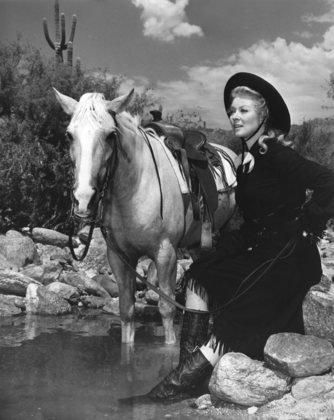
Heather Angel (9 February 1909 – 13 December 1986), was an English actress, who began her stage career at the Old Vic in 1926 and later performed in British films before going to Hollywood.
Her first film was, City of Song. She later had a leading role in Night in Montmartre (1931), and then performed in, The Hound of the Baskervilles (1932).
She later performed in the films: The Mystery of Edwin Drood (1935), The Three Musketeers (1935), The Informer (1935) and The Last of the Mohicans (1936).
In 1937 she made the first of five appearances as Phyllis Clavering in the Bulldog Drummond series.
She was cast as Kitty Bennett in Pride and Prejudice (1940) and as the maid, Ethel, in Suspicion (1941). Angel was also the leading lady inthe film, Time to Kill(1942). She was one of the passengers of Alfred Hitchcock's Lifeboat (1944).
Her film career began to fade, but she returned to Hollywood to provide voices for the Walt Disney animated films Alice in Wonderland (1951) and Peter Pan (1953).
She also performed in television soap opera Peyton Place from 1964 until 1965. After that role, she played Miss Faversham, a nanny and a female friend of Sebastian Cabot's character of Giles French in the television comedy Family Affair.
Angel was married to Robert B. Sinclair, a television director. On 4 January 1970, an intruder broke into their home. When Sinclair was protecting Angel, the intruder killed Sinclair in Angel's presence, then fled. The incident is believed to have been a failed burglary.
She died from cancer in Santa Barbara, California.
William Travilla (March 22, 1920 – November 2, 1990), was an American costume designer for theater, film and television. He maybe best known for dressing Marilyn Monroe in eight of her films.
After working on several B movies, he worked his way to winning an Oscar in 1949 for the Errol Flynn swashbuckler, Adventures of Don Juan, and in 1951 designed the costumes in the classic sci-fi, The Day the Earth Stood Still. He then worked at Twentieth Century-Fox, where designed the costumes for the film, Viva Zapata!.
By 1952, he became good friends with Marilyn Monroe and created the costumes for: Don't Bother to Knock and Gentlemen Prefer Blondes. Travilla created one of the most famous costumes on the silver screen. The pleated white cocktail dress Monroe wore in the film, The Seven Year Itch(1955).
When Travilla began working with Marilyn in 1952 in Don't Bother to Knock, he was still one of the many costume designers of 20th Century Fox.
In 1955 he designed the white cocktail dress worn by Marilyn Monroe while his wife Dona Drake was on vacation. According to Dale McConathy and Diana Vreeland, Travilla did not design the dress, but bought it off the rack (although the costume designer always denied this claim).
The ivory cocktail dress, was a popular style of the 1950's and 1960's. The halter-like bodice was made of two pieces of softly pleated fabric that come together behind the neck, leaving the arms, shoulders and back bare. The dress fits closely to the waistline. A soft and narrow self belt was wrapped around the torso, criss-crossing in front and then tied into a small neat bow at the waist, at the front on the left side. Below the waistband is a softly pleated skirt which reaches to mid-calf or below the calf length. There is a zipper at the back of the bodice, and tiny buttons at the back of the halter.
In the film, the white dress appears in the sequence in which Marilyn Monroe and co-star Tom Ewell are leaving the Theatre, after just watching the 1954 horror film Creature from the Black Lagoon.
When they hear a subway train passing below the grate in the sidewalk, Monroe's character steps onto the grate saying "Ooo, do you feel the breeze from the subway?", as the wind blows the dress up exposing her legs.
Originally the scene had been scheduled to shoot on the street outside the Trans-Lux at 1:00 am on 15 September 1954. However, the presence of the actress and the cameras caught the curiosity of thousands of fans, so the director Billy Wilder was forced to reshoot on a set at 20th Century Fox.
After Monroe's death in 1962, Travilla kept the dress locked up with many of the costumes he had made over the years for the actress, to the point that for years there was talk of a "Lost Collection".
The dress, was later purchased by actress Debbie Reynolds, for $4,600,000 during a 2011 auction.
Monroe once wrote to Travilla, "Billy Dear, please dress me forever. I love you, Marilyn."
Travilla was nominated for the Academy Award for How to Marry a Millionaire(1953), There's No Business Like Show Business(1954) and The Stripper(1963).
Travilla best known project was the TV mini-series, The Thorn Birds(1983).
Travilla was nominated for Emmy awards seven times for his work on television.
In 1980, he won the Emmy for "Outstanding Costume Design for a Limited Series or a Special" for The Scarlett O'Hara War, and in 1985 he won the "Outstanding Costume Design for a Series" Emmy for his work on the television show Knots Landing.
Travilla died on November 2, 1990 in Los Angeles, California, of lung cancer. In 2008 an exhibition of the collection of William Travilla began in England, then came to Los Angeles and in 2009 to Palm Springs, California.
The collection includes gowns worn by: Marilyn Monroe, Dionne Warwick, Whitney Houston, Faye Dunaway, Judy Garland, Sharon Tate, Jane Russell, Betty Grable, Lana Turner, Diahann Carroll, Susan Hayward, Loretta Young, Joanne Woodward and Barbara Stanwyck.
After Tonight (1933). World War I spy film directed by George Archainbaud. The studio considered firing Bennett after the film lost $100,000 at the box office. Cast: Constance Bennett, Gilbert Roland , Edward Ellis, Sam Godfrey, Lucien Prival, Mischa Auer. Bennett sings and does a fan dance! She and Roland later married in real life.
The start of World War I, Carla is befriended by German officer Rudolph Ritter, who seems smitten with her, at the train station while buying a ticket to Vienna.
After the over crowed train drops them at the Austrian border and while her new friend is looking for a car, Carla, kisses him good by and leaves without explanation.
In Vienna, Rudolph's job is to break into a Russian spy ring, unaware that Carla, who is actually Russian, is passing and receiving messages in fake coins under the code name K-14 while posing as a cabaret singer dressed in feathers.
After Carla is searched and almost caught with a message during a performance, she is reassigned to a seamstress' shop. When her fellow spy is shot and killed and her cover is exposed, she flees Vienna one step ahead of Rudolph and becomes a nurse at a German military hospital under new orders. She holds up well while the war is going on right outside the hospitals doors.
Later, one of Carla's messages, which she has written in invisible ink in a book, is intercepted by Rudolph as it is being passed from one agent to another.
Rudolph, travels to a German post and makes a promise that he will catch what is claimed to be the most intelligent spy so far.
They meet again and against her better judgment, they dine and dance and under the moonlight, Carla falls in love with her enemy. He finds evidence implicating her as the spy, after she is arrested while having her hair washed. Rudolph, is reluctant to admit that she is K-14. Forced by his sense of duty, Rudolph traps Carla by passing her a phony order, in the ear of a patient sent to the hospital, to meet a contact in a deserted cottage.
Finally caught by Rudolph, who was hoping something to happen to him to protect Carla, so he would not have to arrest her. As they are leaving, she is rescued by another spy dressed as a gypsy, who shoots and wounds Rudolph during the escape.
After the war is over, Rudolph and Carla meet again at a crowded Swiss train station after two years and are happy to find each other still alive.. they fall into each other's arms.
The film is very well made and the films fast pace, will hold your interest until the very end. The theme song of the film, which Bennett sings, is very sweet. This film may remind you of another spy film, Garbo's MATA HARI.
Virginia Weidler (March 21, 1927 – July 1, 1968) was a child actress, popular in Hollywood films during the 1930s and 1940s. Virginia Weidler made her first film appearance in 1933. Over the next few years, she was cast in minor roles for RKO and Paramount Pictures.
Neither studio made more extensive use of her and when Paramount did not extend her contract, she was signed by MGM in 1938. Her first film for MGM was with their leading male star Mickey Rooney in Love Is a Headache (1938). The film was a success and Weidler was now cast in larger roles, most often as precocious tom-boys.
She was one of the all-female cast of the 1939 film The Women, as Norma Shearer's daughter.
Her next major success was The Philadelphia Story (1940) in which she played Dinah Lord, the witty younger sister of Tracy Lord (Katharine Hepburn).
As a teenager she was less popular with audiences. After a string of box-office disappointments, her film career ended with the 1943 film Best Foot Forward.
At her retirement by age 17, she had appeared in more than forty films, and had acted with some of the biggest stars day: Clark Gable and Myrna Loy in Too Hot to Handle, Bette Davis in All This and Heaven Too and Judy Garland in Babes on Broadway.
On March 27, 1947, Weidler married Lionel Krisel. They had two sons, Ronnie and Gary. Her older brother, saxophonist George Weidler (01/11/1926 – 12/27/1989) was married to Doris Day from March 1946 to May 1949.
Weidler refused to be interviewed for the remainder of her life, living in private. She remained married to Krisel until her death on July 1, 1968 when she suffered a heart attack in Los Angeles at age 41.
Kirsten Dunst in The Cat's Meow (2001). A period drama directed by Peter Bogdanovich, and starring Kirsten Dunst, Eddie Izzard, Edward Herrmann, Cary Elwes, Joanna Lumley and Jennifer Tilly. The screenplay by Steven Peros is based on his play of the same title, which was inspired by the mysterious death of film mogul Thomas H. Ince.
The film takes place aboard publisher William Randolph Hearst's yacht on a weekend cruise celebrating Ince's 42nd birthday in November 1924. Among those in attendance are Hearst's longtime companion and film actress Marion Davies, fellow actor Charlie Chaplin, writer Elinor Glyn, columnist Louella Parsons, and actress Margaret Livingston.
The celebration is cut short by an unusual death that would go on to become the subject of legendary Hollywood folklore.
Melanie Griffith in RKO 281 (1999) (TV). RKO 281 is a 1999 historical drama film directed by Benjamin Ross. It stars Liev Schreiber, James Cromwell, Melanie Griffith, John Malkovich, Roy Scheider and Liam Cunningham.
The film is about the troubled production behind the 1941 film Citizen Kane. The film's title is a reference to the original production number of Citizen Kane.
Virginia Madsen in The Hearst and Davies Affair (1985) (TV). The Story of the decades-long affair between married newspaper magnate and movie producer William Randolph Hearst and actress and former "Ziegfeld Follies" showgirl Marion Davies.
Heather McNair in Chaplin (1992). A biographical film about the life of British comedian Charlie Chaplin. It was produced and directed by Richard Attenborough and stars Robert Downey, Jr., Moira Kelly, Dan Aykroyd, Penelope Ann Miller, and Kevin Kline. It also features Geraldine Chaplin in the role of her own paternal grandmother, Hannah Chaplin.
The film was adapted by William Boyd, Bryan Forbes and William Goldman from the books My Autobiography by Chaplin and Chaplin: His Life and Art by film critic David Robinson. Associate producer Diana Hawkins got a story credit. The original music score was composed by John Barry.
Strange Lady in Town (1955). Starring Greer Garson. She plays a female doctor who plans to introduce modern medicine to old Santa Fe, but is opposed by an established doctor played by Dana Andrews.
Her Twelve Men (1954). A comedy/drama made by MGM.
Jan Stewart, becomes teacher and mother-figure to a class of twelve and must prove herself to Joe Hargrave, head of the boarding school, who is concerned about Jan's inexperience.
Scandal At Scourie (1953). A young girl named Patsy lives in an orphanage in Quebec. After, she burns down the orphanage, she finds a new home with the McChesney's, who live in Protestant Ottawa.
Victoria is excited about the new family member, Patrick is not as happy about the girl coming to live with them. After Victoria, overcomes being ill from poisonous mushrooms, that Patsy collected. Victoria is suspected of causing the flame cleaning of the local school.
They can not find any evidence against Patsy. McChesney declares to give up his candidature in order to accept Patsy as his daughter. Patsy, runs away. Will her innocence ever be proven?
Last of eight movies that paired Greer Garson and Walter Pidgeon. The others are Blossoms in the Dust, Mrs. Miniver, Madame Curie, Mrs. Parkington, Julia Misbehaves, That Forsyte Woman and The Miniver Story.
Sunrise At Campobello (1960). The story of Franklin Roosevelt's life changing experence with polio at age 40 in 1921 and how his family (and especially wife Eleanor) deal with his illness.
From being stricken while vacationing at Campobello to his triumphant nominating speech for Al Smith's presidency in 1924, the story follows the influences on his life and his determination to recover. Based on the award winning Broadway play of the same name.
The Singing Nun(1966). A Belgian nun, Sister Ann is sent to another order where she's at first committed to helping others.
After Father Clementi enters her in a singing contest, Sister Ann is signed to a record deal so everyone can hear her wonderful songs.
However, Sister Ann is unprepared for her new found fame (like appearing on the "Ed Sullivan" show) and the unwanted attraction to an old friend, Robert.
Brewster's Millions (1945), is one of the many of adaptations of the novel of the same name by George Barr McCutcheon. The film was banned in Memphis, Tennessee because the character of an African-American servant, portrayed by Eddie "Rochester" Anderson, was treated too well. Directed by Allan Dwan. Cast: Dennis O'Keefe, Helen Walker and June Havoc.
Soon after getting out of the Army, Montague "Monty" L. Brewster learns that his uncle, who made his money in Bolivian tin, has died and left him eight million dollars. Monty, who is engaged to Peggy Gray, is thrilled, but.. learns from his uncle's lawyer, Swearengen Jones, that the will stipulates that he must spend one million dollars by noon on his thirtieth birthday to receive the rest of the money.
After learning that the one million dollars cannot be spent frivolously or given away, Monty, thinks that he can spend the million in two months time without any problem, until.. Jones informs him that he cannot marry during the sixty days and must swear a vow of secrecy of the will's terms(so his friends can't help or hinder him).
Peggy, becomes concerned that the money has already changed Monty, when he says he must postpone the wedding, until he gives her an expensive engagement ring.
Monty's Army buddies, Noppy Harrison and Hacky Smith, are also confused by Monty's sudden wild spending spree, but.. agree to help him with his new business, Brewster and Co. Within a week, Monty has spent $300,000 on bad investments and a lavish party hosted by heiress Barbara Drew and over paying his employees.
His plan begins to backfire when, his bad investments start paying off and he learns that he has won a $25,000 radio contest.
Also Peggy, is becoming jealous of Barbara and angry over his spending habits.
Looking for a way to spend his money, Monty decides to put $95,000 into a Broadway production, starring chorus girl Trixie Summers and buys her a fur coat as an investment. As hoped, the play is a flop, but Nopper and Hacky, close the show and lease the theater, before the show loses any more money.
Monty decides to take the production on board the expensive Drew family yacht and conduct a goodwill tour of East Coast naval bases. After, postponing his wedding again, believing that Monty is interested in both Barbara and Trixie, Peggy breaks off their engagement.
On advice from her mother, Peggy changes her mind and makes up with Monty. Until, Peggy,sees her engagement ring, on Trixie's finger.
After Peggy, threatens to get off the ship in Florida, Monty orders the ship's captain to sail directly to the Caribbean. Nopper and Hacky, convince the captain to head back to New York.
To add to his problems, the cast of the show announces that they are donating their services for the war effort. Monty's fortune appears lost until the yacht hits a floating mine and Monty hires the Navy to tow the damaged boat for $400,000.
Back in New York, on his thirtieth birthday, Monty, having spent the one million dollars, waits for Jones with his receipts. Wanting to help, Nopper, Hacky, Trixie, Barbara and the Grays's servant Jackson insist on giving money to the now broke Monty.
Monty is $40,012 richer by the time Jones shows up, but as the clock starts to strike twelve... will he figure out a way to get rid of his new found earnings?
This film is just a fun way to spend a Sunday afternoon and maybe, think up a few ways you would spend the money to earn the inheritance..
Helen Walker (born July 17, 1920 – March 10, 1968), was a beautiful actress whose career never reached its full potential.
She was a successful actress on Broadway and in 1942 her performance in the play "Jason" was so impressive that she was signed up to act in films.
She immediately received star billing in her film debut, Lucky Jordan (1942), starring Alan Ladd.
During the mid-1940's she had continued success with performances in successful films: The Man in Half Moon Street (1945), Brewster's Millions (1945) and the murder spoof Murder, He Says (1945), which starred Fred MacMurray.
She landed the starring role in the film Heaven Only Knows (1947) and things were going very well for her, but.. all that changed on December 31, 1946, while driving the car of director Bruce "Lucky" Humberstone from Palm Springs to Hollywood, she gave a ride to three hitchhiking soldiers named Robert E. Lee, Philip Mercado, and Joseph Montaldo.
Near Redlands, California, the car hit a divider and flipped over, killing Lee and causing serious injuries to Helen and the other two passengers.
She was charged with drunk driving and reckless driving, and Mercado brought a civil suit for $150,000 against her.
Her criminal trial for manslaughter ended with a dismissal on the motion of San Bernardino County District Attorney Jerome B. Kavanaugh.
She was married to Paramount studio lawyer Robert Blumofe (1942, divorced 1946) and department store executive Edward DuDomaine (1950, divorced 1952).
When her house burned in 1960, other actresses held a benefit to help her.
Gun Crazy(1949). Noir. Cast: Peggy Cummins and John Dall. Director: Joseph H. Lewis, and produced by Frank King and Maurice King. Screenplay: Dalton Trumbo (credited to Millard Kaufman because of the Hollywood Blacklist), and MacKinlay Kantor was based upon a short story by Kantor published in 1940 in The Saturday Evening Post Gun Crazy was selected for the National Film Registry, and is also known as... Deadly Is the Female.(1950).
The bank robbery scene was done in one take, with no one except the actors and people inside the bank knowing that a movie was being filmed. When John Dall as Bart Tare says, "I hope we find a parking space," he really meant it. At the end of the scene when someone in the background screams that there's been a bank robbery... this was a bystander who saw the filming and really thought there was a bank robbery going down.
Video: As it's raining heavily, the young husband and wife do not seem to worried about it at first. But, the husband gets soaked on the way home from work and when he finds that the butler has left all of his suits hanging outside in the rain, their troubles have just begun.
One of the most entertaining, unusual, and underrated of
silent screen comediennes was Alice Howell, a famous vaudevillian.
Alice Howell was born Alice Cook in New York on May 20,
1886, and took her stage name from a vaudeville act, Howell and Howell that she
and her husband, Dick Smith replaced.
The couple entered films in 1913 with Mack Sennett,
appearing together as party guests in Tillie’s Punctured Romance (1914). Alice
can be seen in a number of Charlie Chaplin’s Keystone shorts, most notably as
the dentist’s wife in Laughing Gas(1914).
Alice became a comedy star with Henry “Pathe” Lehrman’s
Knock-Out Komedies made by his L-KoMotion Picture in 1915.At
L-Ko, Alice hid her natural beauty and developed a unique eccentric style of
dress with ill-fitting clothing, her hair piled into a mess of golden curls and
topped with the most unsuitable hats. Her eyebrows were over emphasized and her
walk was more like a penguin.
Alice was no light or polite comedienne, she was a physical
comic who could handle anything better than any male. It’s no exaggeration to
describe Alice as the female counterpart of Charlie Chaplin.
While Chaplin had his tramp costume, Alice had her scrub
lady outfit. However, while Chaplin developed his comedy for the feature-length
film, Alice was stuck in short subjects for most of her career, moving from
L-Ko to Reelcraft, to Universal in the early 1920’s, and, finally, to Fox for a
couple of titles in 1926 and 1927.
Unlike Chaplin, Alice didn’t really care much about her film
career. Alice made films in order to make money, and she invested her money in
real estate. By the late 1920’s, she had no need to work and all she cared
about was real estate.
Alice Howell died a wealthy woman in Los Angeles on April
11, 1961. Her passing went unrecorded in both the trade and the popular press.
Alice Howell had an extensive filmography with more than 80
titles. Some of the titles are intriguing such as Silk Hose and High Pressure
(1915), Lizzy’s Lingering Love (1916), Tilly’s Terrible Tumbles (1916), and
Beauty and the Boob (1919).
If someone would screen Alice Howell’s films today, she
would probably generate more laughter than Mabel Normand.
Man of the World (1931). Directed by Richard Wallace. Cast: William Powell, Carole Lombard, Wynne Gibson, Lawrence Gray. This was the first of three movies that Powell and Lombard made together. They met on the set and married the same year the movie was released.
Michael Trevor, began his career as a newspaper writer named Jimmie Powers, but because of a huge scandal he leaves the United States. He now runs a scandal newspaper in Paris, making a living on exposing wealthy American men, who come to Paris with their mistresses, but.. as a gentleman, Michael refuses to blackmail women.
Michael's latest story is about Harold Taylor, the soft coal baron of Pennsylvania. Saying that he is a novelist, Michael befriends Taylor, by suggesting that he prosecute the editor of a scandal newspaper, who is about to print a story about him and a beautiful blonde.
Taylor asks Michael to give the editor $2,000 to keep quiet. Soon after he meets Taylor's niece, Mary Kendall, who is in Paris with her boyfriend, Frank Thompson.
After, Frank leaves for business in London, Mary and Michael spend time together and fall in love. He decides to tell her the truth about himself and promises to be a better man, she believes him and accepts his marriage proposal.
Michael's, soon to be ex-girl friend, Irene Harper, who works with him on the scandal sheet, was hoping that Michael would swindle Taylor, out of the money she needed to post bail for her brother back in America.
When Michael tells her that he and Mary are going to marry, Irene goes into a jealous rage and convinces Michael he will never change and that marriage to an ex-con would be unfair to Mary. He agrees with her and tries to convince Mary, that he can not change after all with a scandalous story about Mary and Michael visiting a inn, and wants $10,000 to keep quiet. Will Mary, agree to have her uncle write Michael a check and will Irene, get her revenge for being dumped?
If you are in the mood for a slower paced Powell and Lombard film and the film that brought about their marriage. This film is for you.
Wynne Gibson (July 3, 1905 – May 15, 1987), began her stage career in chorus and was soon playing leads.
She toured Europe then returned to America and tried for a dramatic part but failed and returned to musical comedy.
Paramount signed her on when she was about to film, Nothing But the Truth (1929), which starting her success which continued in 50 films between 1929 and 1956 although many were B movies.
Gibson was a long-time companion of former Warner Brothers actress, Beverly Roberts.
Gibson died in 1987 of a cerebral thrombosis in Laguna Niguel, California, after suffering an attack in the home she shared with Roberts.
Orchestra Wives(1942). Cast: Ann Rutherford and George Montgomery, Lynn Bari, Carole Landis, Cesar Romero, Virginia Gilmore, Mary Beth Hughes and The Nicholas Brothers. The film was the second and last film to feature The Glenn Miller Orchestra. Maureen O'Hara and Linda Darnell both declined the female lead.
Connie Ward marries Bill Abbott, a trumpet player in Gene Morrison's swing band. She soon finds herself having trouble with the other band member's wives. She is also worried by the flirtation between Abbott and Jaynie, the band's female singer.
When Ward decides to walk out on Abbott, the troubles among the musicians and their wives, come to a head and band leader Morrison, is forced to break up the orchestra. Ward and the band's pianist Sinjin then work together to reunite the band, which also produces a reconciliation between Ward and Abbot.
Orchestra Wives features many wonderful songs by Mack Gordon and Harry Warren, who were also responsible for the songs featured in Miller's first film, Sun Valley Serenade (1941). The main production number is "I've Got a Gal in Kalamazoo".
"Chattanooga Choo-Choo", from the first film that features a vocals and sax by Tex Beneke, backup singing by the Modernaires, and the dance sequence by the Nicholas Brothers.
Other songs include: "People Like You and Me", "Bugle Call Rag"..
and the romantic ballads "At Last"..
"Serenade in Blue"...
The film score uses "At Last" as a musical motif that is played throughout the movie.
Glenn Miller's theme song "Moonlight Serenade" from 1939 also appears over the opening credits.
"Boom Shot", an instrumental composed by Glenn Miller and Billy May for the movie, also is played in the movie, first on the jukebox in the soda shop, then when Ann Rutherford and Harry Morgan are shown dancing.
Three future stars have uncredited appearances: Jackie Gleason plays the band's bass player, Ben Beck, and in the soda fountain scene, Harry Morgan is the soda-jerk Cully Anderson, who also dates Connie Ward (Ann Rutherford).
In her movie debut, Dale Evans plays Ann Rutherford's friend Hazel. Pat Friday dubbed Lynn Bari's singing, as she had done in Sun Valley Serenade. George Montgomery's on-screen trumpet playing was performed on the soundtrack by Johnny Best.
I love this movie and the glamorous fashions of the day. The plot showcases the toe tapping music and singing. Also, what fun it is to see Jackie Gleason playing the bass. This wonderful movie seems to be almost unknown, yet it should be on the top of the list of every Glenn Miller fan.
Ann Rutherford began her film career in starring roles in Waterfront Lady for Mascot Pictures in 1935.
Mascot merged with Republic Pictures and Rutherford soon became a popular leading lady of Westerns with Gene Autry and John Wayne.
Afterward, she was placed under contract with MGM, where she performed in films: A Christmas Carol (1938) and Pride and Prejudice (1940).
She was loaned to Selznick International to perform as, Carreen O'Hara in Gone with the Wind (1939).
From 1937 until 1942, she played Polly Benedict in the Andy Hardy series.
She also performed in a series of mystery/comedies with Red Skelton, Whistling in the Dark (1941), Whistling in Dixie (1942), and Whistling in Brooklyn (1943).
In Washington Melodrama (1941). She left MGM to freelance in the early 1940's, starring in such films as Orchestra Wives (1942), Two O'Clock Courage (1945) and The Secret Life of Walter Mitty (1947).